 f539580138
* feat: migrate multi-vector query and reranker logic to C++ - Add Reranker base class with RrfReRanker and WeightedReRanker implementations - Add Collection::MultiQuery interface for multi-vector queries with reranking - Add MultiVectorQuery struct in doc.h with forward declaration for Reranker - Add C API bindings for reranker and MultiQuery (zvec_reranker_*, zvec_multi_vector_query_*, zvec_collection_multi_query) - Add Python binding for reranker classes with py::function bridge for callback - Validate duplicate field names in multi-vector queries (C++ and Python consistent) - Remove TODO comment about concurrent execution (SQLEngine is not thread-safe) - Update collection.h MultiQuery doc comment from concurrently to sequentially - Add C++ collection tests (6 MultiQuery test cases) - Add C API tests (reranker functions + multi_vector_query end-to-end) - Implement Python test cases (11 previously skipped tests now active) - Simplify Python query_executor validation for unified duplicate field check * style: format Python files with ruff * fix: adapt to main branch API changes (VectorQuery->Query rename, validate_and_sanitize) * fix: multi_vector tests now use multiple same-type vector fields (dense2, sparse2) * fix: suppress RET501 for intentional default return None in RerankFunction._get_object * style: ruff format test_collection.py * refact multi vector query * format code * fix(multi-vector): expose SubVectorQuery in Python binding, fix tests - Register _SubVectorQuery in pybind11 with from_vector_query() factory - Convert _VectorQuery to _SubVectorQuery in MultiVectorQueryExecutor - Relax RRF/Weighted score assertion tolerance from 1e-10 to 1e-6 - Fix WeightedReRanker test metric to IP (matching HnswIndexParam default) * style: ruff format query_executor.py * fix: define _USE_MATH_DEFINES for M_PI on Windows (MSVC) * refactor: include reranker.h directly in query.h instead of forward declaration * refactor(reranker): move topn from member variable to rerank() parameter * refact code * style(python): fix ruff UP035/UP037 in multi_vector_reranker - import Callable from collections.abc instead of typing (UP035) - remove redundant quotes around MetricType annotations (UP037) * chore: trigger PR sync * refact code * fix(examples): restore CMakeLists.txt formatting broken by clang-format * refactor(reranker): remove redundant metrics_ map by querying schema directly, and use insert return value to avoid duplicate set lookup * refactor(reranker): defer schema binding to query time and remove C API callback reranker |
||
|---|---|---|
| .github | ||
| cmake | ||
| examples | ||
| python | ||
| scripts | ||
| src | ||
| tests | ||
| thirdparty | ||
| tools | ||
| .clang-format | ||
| .clang-tidy | ||
| .gitignore | ||
| .gitmodules | ||
| .pre-commit-config.yaml | ||
| CMakeLists.txt | ||
| CODE_OF_CONDUCT.md | ||
| CONTRIBUTING.md | ||
| LICENSE | ||
| README.md | ||
| README_CN.md | ||
| pyproject.toml | ||
README.md
English | 中文






🚀 Quickstart | 🏠 Home | 📚 Docs | 📊 Benchmarks | 🔎 DeepWiki | 🎮 Discord | 🐦 X (Twitter)
Zvec is an open-source, in-process vector database — lightweight, lightning-fast, and designed to embed directly into applications. Battle-tested within Alibaba Group, it delivers production-grade, low-latency and scalable similarity search with minimal setup.
[!Important] 🚀 v0.4.0 (May 9, 2026)
- Dart/Flutter SDK: Published the official zvec Flutter package with FFI bindings. Supports Android (arm64-v8a) and iOS (arm64) — no manual native compilation required.
- iOS Build Support: Added support for building on iOS platforms, expanding cross-platform coverage.
- Enlarged topK Limit: Relaxed the upper bound on topK to support larger-scale recall scenarios.
- Bug Fixes: SQ8 quantizer recall drop; Windows path handling; sparse vector index ordering.
💫 Features
- Blazing Fast: Searches billions of vectors in milliseconds.
- Simple, Just Works: Install and start searching in seconds. Pure local, no servers, no config, no fuss.
- Dense + Sparse Vectors: Work with both dense and sparse embeddings, with native support for multi-vector queries in a single call.
- Hybrid Search: Combine semantic similarity with structured filters for precise results.
- Durable Storage: Write-ahead logging (WAL) guarantees persistence — data is never lost, even on process crash or power failure.
- Concurrent Access: Multiple processes can read the same collection simultaneously; writes are single-process exclusive.
- Runs Anywhere: As an in-process library, Zvec runs wherever your code runs — notebooks, servers, CLI tools, or even edge devices.
📦 Installation
Python
Requirements: Python 3.10 - 3.14
pip install zvec
Node.js
npm install @zvec/zvec
✅ Supported Platforms
- Linux (x86_64, ARM64)
- macOS (ARM64)
- Windows (x86_64)
🛠️ Building from Source
If you prefer to build Zvec from source, please check the Building from Source guide.
⚡ One-Minute Example
import zvec

# Define collection schema
schema = zvec.CollectionSchema(
    name="example",
    vectors=zvec.VectorSchema("embedding", zvec.DataType.VECTOR_FP32, 4),
)

# Create collection
collection = zvec.create_and_open(path="./zvec_example", schema=schema)

# Insert documents
collection.insert([
    zvec.Doc(id="doc_1", vectors={"embedding": [0.1, 0.2, 0.3, 0.4]}),
    zvec.Doc(id="doc_2", vectors={"embedding": [0.2, 0.3, 0.4, 0.1]}),
])

# Search by vector similarity
results = collection.query(
    zvec.VectorQuery("embedding", vector=[0.4, 0.3, 0.3, 0.1]),
    topk=10
)

# Results: list of {'id': str, 'score': float, ...}, sorted by relevance
print(results)
📈 Performance at Scale
Zvec delivers exceptional speed and efficiency, making it ideal for demanding production workloads.
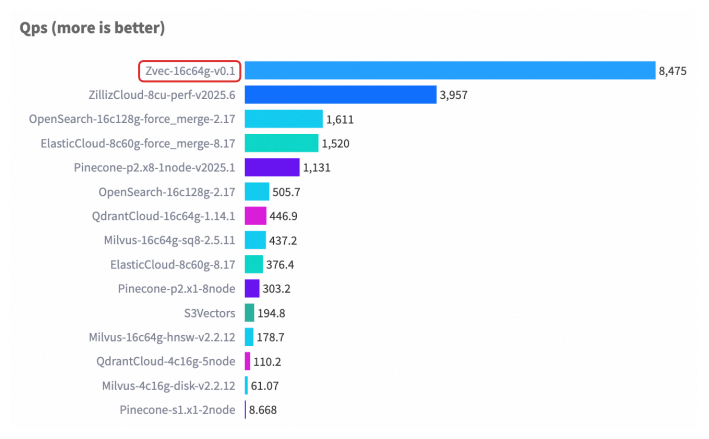
For detailed benchmark methodology, configurations, and complete results, please see our Benchmarks documentation.
🤝 Join Our Community
| 💬 DingTalk | 🎮 Discord | X (Twitter) | |
|---|---|---|---|
 |
 |
 |
 |
| Scan to join | Scan to join | Click to join | Click to follow |
❤️ Contributing
We welcome and appreciate contributions from the community! Whether you're fixing a bug, adding a feature, or improving documentation, your help makes Zvec better for everyone.
Check out our Contributing Guide to get started!