 e3e8b76ddb
* feat(examples): add custom HTTP embedding example for LM Studio / Ollama * feat(extension): promote HTTPDenseEmbedding to first-class extension Move the HTTP embedding implementation from the example script into python/zvec/extension/ as HTTPDenseEmbedding, inheriting from DenseEmbeddingFunction. The example now imports from zvec.extension instead of defining the class inline. Signed-off-by: Maxime <maxime@cluster2600.com> Signed-off-by: Maxime Grenu <maxime.grenu@gmail.com> * fix(examples): resolve ruff lint errors in HTTP embedding example Move zvec imports to top-level, add noqa for print statements, replace os.path.exists with pathlib, fix import sorting. Signed-off-by: Maxime <maxime@cluster2600.com> Signed-off-by: Maxime Grenu <maxime.grenu@gmail.com> * style: apply ruff formatter Signed-off-by: Maxime <maxime@cluster2600.com> Signed-off-by: Maxime Grenu <maxime.grenu@gmail.com> * ci: retrigger CI (flaky macOS C++ test) The vector_column_indexer_test failure is a known flaky assertion in hnsw_streamer_entity.h, unrelated to Python-only changes in this PR. Signed-off-by: Maxime <maxime@cluster2600.com> Signed-off-by: Maxime Grenu <maxime.grenu@gmail.com> * chore: remove custom HTTP embedding example Per maintainer feedback, examples requiring an external LLM server belong in the zvec-web project rather than in this repository. Signed-off-by: Maxime Grenu <maxime.grenu@gmail.com> --------- Signed-off-by: Maxime <maxime@cluster2600.com> Signed-off-by: Maxime Grenu <maxime.grenu@gmail.com> |
||
|---|---|---|
| .github | ||
| cmake | ||
| examples/c++ | ||
| python | ||
| scripts | ||
| src | ||
| tests | ||
| thirdparty | ||
| tools | ||
| .clang-format | ||
| .gitignore | ||
| .gitmodules | ||
| .pre-commit-config.yaml | ||
| CMakeLists.txt | ||
| CODE_OF_CONDUCT.md | ||
| CONTRIBUTING.md | ||
| LICENSE | ||
| README.md | ||
| pyproject.toml | ||
README.md




🚀 Quickstart | 🏠 Home | 📚 Docs | 📊 Benchmarks | 🎮 Discord
Zvec is an open-source, in-process vector database — lightweight, lightning-fast, and designed to embed directly into applications. Built on Proxima (Alibaba's battle-tested vector search engine), it delivers production-grade, low-latency, scalable similarity search with minimal setup.
💫 Features
- Blazing Fast: Searches billions of vectors in milliseconds.
- Simple, Just Works: Install and start searching in seconds. No servers, no config, no fuss.
- Dense + Sparse Vectors: Work with both dense and sparse embeddings, with native support for multi-vector queries in a single call.
- Hybrid Search: Combine semantic similarity with structured filters for precise results.
- Runs Anywhere: As an in-process library, Zvec runs wherever your code runs — notebooks, servers, CLI tools, or even edge devices.
📦 Installation
Python
Requirements: Python 3.10 - 3.12
pip install zvec
Node.js
npm install @zvec/zvec
✅ Supported Platforms
- Linux (x86_64, ARM64)
- macOS (ARM64)
🛠️ Building from Source
If you prefer to build Zvec from source, please check the Building from Source guide.
⚡ One-Minute Example
import zvec

# Define collection schema
schema = zvec.CollectionSchema(
    name="example",
    vectors=zvec.VectorSchema("embedding", zvec.DataType.VECTOR_FP32, 4),
)

# Create collection
collection = zvec.create_and_open(path="./zvec_example", schema=schema)

# Insert documents
collection.insert([
    zvec.Doc(id="doc_1", vectors={"embedding": [0.1, 0.2, 0.3, 0.4]}),
    zvec.Doc(id="doc_2", vectors={"embedding": [0.2, 0.3, 0.4, 0.1]}),
])

# Search by vector similarity
results = collection.query(
    zvec.VectorQuery("embedding", vector=[0.4, 0.3, 0.3, 0.1]),
    topk=10
)

# Results: list of {'id': str, 'score': float, ...}, sorted by relevance
print(results)
📈 Performance at Scale
Zvec delivers exceptional speed and efficiency, making it ideal for demanding production workloads.
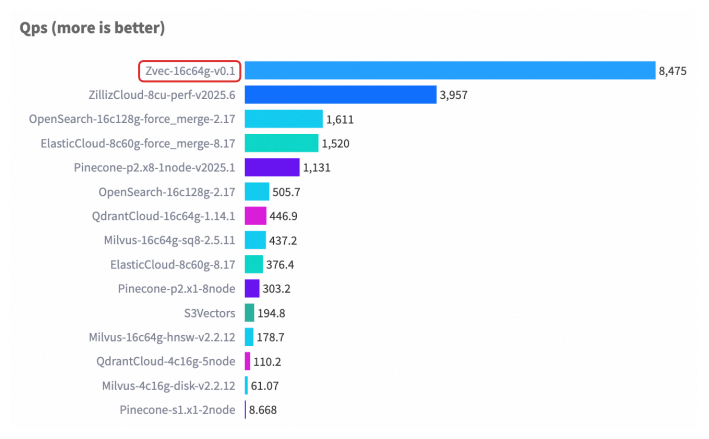
For detailed benchmark methodology, configurations, and complete results, please see our Benchmarks documentation.
🤝 Join Our Community
Stay updated and get support — scan or click:
| 💬 DingTalk | 🎮 Discord | |
|---|---|---|
 |
 |
 |
| Scan to join | Scan to join | Click to join |
❤️ Contributing
We welcome and appreciate contributions from the community! Whether you're fixing a bug, adding a feature, or improving documentation, your help makes Zvec better for everyone.
Check out our Contributing Guide to get started!