 beb047095f
- Added compact COCO RLE mask ingestion with a `CompactMask` representation and optional compact mask parsing during inference for substantially lower memory usage on sparse segmentation results.
- Added `Detections.to_compact_masks()` to convert existing dense masks into compact masks while preserving detection and collection metadata.
- Improved compact mask decoding performance with cropped RLE processing, batched decoding on the fast path, vectorized decoding for small images, optimized RLE traversal, and faster delta decoding.
- Improved mask metrics to operate directly on `CompactMask` instances, preserving the compact representation while producing results equivalent to dense masks.
- Fixed mixed-modality inference handling by keeping detections and masks aligned, isolating malformed RLE failures to individual predictions where possible, and falling back safely when decoding cannot be completed.
- Fixed compact mask conversion and parsing to preserve dense-mask pixel content across public parsing and slicing paths, while correctly documenting and applying the intended bbox-cropping behavior for compact COCO RLE masks.
- Improved COCO RLE validation with checks for malformed payloads, invalid dimensions, count overflows, image size limits, count-sum mismatches, bounding-box mismatches, and safe fallback behavior for incompatible mask sizes.
- Added inference benchmarks and documentation demonstrating the memory and inference-time characteristics of compact masks, including guidance on their performance tradeoffs and behavior.

---------

Co-authored-by: Codex <codex@openai.com>
Co-authored-by: claude[bot] <209825114+claude[bot]@users.noreply.github.com>
Co-authored-by: pre-commit-ci[bot] <66853113+pre-commit-ci[bot]@users.noreply.github.com>
Co-authored-by: Copilot Autofix powered by AI <175728472+Copilot@users.noreply.github.com>
3145 lines
114 KiB
Python
3145 lines
114 KiB
Python
from __future__ import annotations
|
|
|
|
from collections.abc import Iterator
|
|
from dataclasses import dataclass, field
|
|
from functools import reduce
|
|
from typing import Any, cast
|
|
|
|
import numpy as np
|
|
import numpy.typing as npt
|
|
from deprecate import deprecated, void
|
|
|
|
from supervision.config import (
|
|
CLASS_NAME_DATA_FIELD,
|
|
ORIENTED_BOX_COORDINATES,
|
|
)
|
|
from supervision.detection.compact_mask import CompactMask
|
|
from supervision.detection.tools.transformers import (
|
|
process_transformers_detection_result,
|
|
process_transformers_v4_segmentation_result,
|
|
process_transformers_v5_segmentation_result,
|
|
)
|
|
from supervision.detection.utils._typing import (
|
|
_DetectionDataType,
|
|
_DetectionDataValueType,
|
|
_MetadataType,
|
|
)
|
|
from supervision.detection.utils.boxes import obb_polygon_area, xyxyxyxy_to_xyxy
|
|
from supervision.detection.utils.converters import (
|
|
mask_to_xyxy,
|
|
polygon_to_mask,
|
|
xywh_to_xyxy,
|
|
)
|
|
from supervision.detection.utils.internal import (
|
|
extract_ultralytics_masks,
|
|
get_data_item,
|
|
is_data_equal,
|
|
is_metadata_equal,
|
|
merge_data,
|
|
merge_metadata,
|
|
process_roboflow_result,
|
|
)
|
|
from supervision.detection.utils.iou_and_nms import (
|
|
OverlapMetric,
|
|
box_iou_batch,
|
|
box_non_max_merge,
|
|
box_non_max_suppression,
|
|
mask_iou_batch,
|
|
mask_non_max_merge,
|
|
mask_non_max_suppression,
|
|
oriented_box_non_max_merge,
|
|
oriented_box_non_max_suppression,
|
|
)
|
|
from supervision.detection.utils.masks import calculate_masks_centroids
|
|
from supervision.detection.vlm import (
|
|
LMM,
|
|
VLM,
|
|
_validate_vlm_parameters,
|
|
from_deepseek_vl_2,
|
|
from_florence_2,
|
|
from_google_gemini_2_0,
|
|
from_google_gemini_2_5,
|
|
from_moondream,
|
|
from_paligemma,
|
|
from_qwen_2_5_vl,
|
|
from_qwen_3_vl,
|
|
)
|
|
from supervision.geometry.core import Position
|
|
from supervision.utils.internal import get_instance_variables, warn_deprecated
|
|
from supervision.validators import _validate_detections_fields, _validate_resolution
|
|
|
|
|
|
@dataclass
|
|
class Detections:
|
|
"""
|
|
The `sv.Detections` class in the Supervision library standardizes results from
|
|
various object detection and segmentation models into a consistent format. This
|
|
class simplifies data manipulation and filtering, providing a uniform API for
|
|
integration with Supervision [trackers](/trackers/), [annotators](/latest/detection/annotators/), and [tools](/detection/tools/line_zone/).
|
|
|
|
=== "Inference"
|
|
|
|
Use [`sv.Detections.from_inference`](/detection/core/#supervision.detection.core.Detections.from_inference)
|
|
method, which accepts model results from both detection and segmentation models.
|
|
|
|
```python
|
|
import cv2
|
|
import supervision as sv
|
|
from inference import get_model
|
|
|
|
model = get_model(model_id="yolov8n-640")
|
|
image = cv2.imread("<SOURCE_IMAGE_PATH>")
|
|
results = model.infer(image)[0]
|
|
detections = sv.Detections.from_inference(results)
|
|
```
|
|
|
|
=== "Ultralytics"
|
|
|
|
Use [`sv.Detections.from_ultralytics`](/detection/core/#supervision.detection.core.Detections.from_ultralytics)
|
|
method, which accepts model results from both detection and segmentation models.
|
|
|
|
```python
|
|
import cv2
|
|
import supervision as sv
|
|
from ultralytics import YOLO
|
|
|
|
model = YOLO("yolov8n.pt")
|
|
image = cv2.imread("<SOURCE_IMAGE_PATH>")
|
|
results = model(image)[0]
|
|
detections = sv.Detections.from_ultralytics(results)
|
|
```
|
|
|
|
=== "Transformers"
|
|
|
|
Use [`sv.Detections.from_transformers`](/detection/core/#supervision.detection.core.Detections.from_transformers)
|
|
method, which accepts model results from both detection and segmentation models.
|
|
|
|
```python
|
|
import torch
|
|
import supervision as sv
|
|
from PIL import Image
|
|
from transformers import DetrImageProcessor, DetrForObjectDetection
|
|
|
|
processor = DetrImageProcessor.from_pretrained("facebook/detr-resnet-50")
|
|
model = DetrForObjectDetection.from_pretrained("facebook/detr-resnet-50")
|
|
|
|
image = Image.open("<SOURCE_IMAGE_PATH>")
|
|
inputs = processor(images=image, return_tensors="pt")
|
|
|
|
with torch.no_grad():
|
|
outputs = model(**inputs)
|
|
|
|
width, height = image.size
|
|
target_size = torch.tensor([[height, width]])
|
|
results = processor.post_process_object_detection(
|
|
outputs=outputs, target_sizes=target_size)[0]
|
|
detections = sv.Detections.from_transformers(
|
|
transformers_results=results,
|
|
id2label=model.config.id2label)
|
|
```
|
|
|
|
Attributes:
|
|
xyxy: An array of shape `(n, 4)` containing
|
|
the bounding boxes coordinates in format `[x1, y1, x2, y2]`
|
|
mask: An array of shape `(n, H, W)` containing the segmentation masks
|
|
(`bool` data type), or `None` when masks are not available, or as
|
|
:class:`~supervision.detection.compact_mask.CompactMask`.
|
|
confidence: An array of shape `(n,)` containing the confidence scores
|
|
of the detections, or `None` when confidence values are not available.
|
|
class_id: An array of shape `(n,)` containing the class ids of the
|
|
detections, or `None` when class ids are not available.
|
|
tracker_id: An array of shape `(n,)` containing the tracker ids of the
|
|
detections, or `None` when tracker ids are not available.
|
|
data: A dictionary containing additional
|
|
data where each key is a string representing the data type, and the value
|
|
is either a NumPy array or a list of corresponding data.
|
|
metadata: A dictionary containing collection-level metadata
|
|
that applies to the entire set of detections. This may include information such
|
|
as the video name, camera parameters, timestamp, or other global metadata.
|
|
""" # noqa: E501 // docs
|
|
|
|
xyxy: npt.NDArray[np.number]
|
|
mask: npt.NDArray[np.bool_] | CompactMask | None = None
|
|
confidence: npt.NDArray[np.floating] | None = None
|
|
class_id: npt.NDArray[np.integer] | None = None
|
|
tracker_id: npt.NDArray[np.integer] | None = None
|
|
data: _DetectionDataType = field(default_factory=dict)
|
|
metadata: _MetadataType = field(default_factory=dict)
|
|
|
|
def __post_init__(self) -> None:
|
|
_validate_detections_fields(
|
|
xyxy=self.xyxy,
|
|
mask=self.mask,
|
|
confidence=self.confidence,
|
|
class_id=self.class_id,
|
|
tracker_id=self.tracker_id,
|
|
data=self.data,
|
|
)
|
|
|
|
def __len__(self) -> int:
|
|
"""
|
|
Returns the number of detections in the Detections object.
|
|
"""
|
|
return len(self.xyxy)
|
|
|
|
def __iter__(
|
|
self,
|
|
) -> Iterator[
|
|
tuple[
|
|
npt.NDArray[np.number],
|
|
npt.NDArray[np.bool_] | None,
|
|
np.generic | None,
|
|
np.generic | None,
|
|
np.generic | None,
|
|
_DetectionDataType,
|
|
]
|
|
]:
|
|
"""
|
|
Iterates over the Detections object and yield a tuple of
|
|
`(xyxy, mask, confidence, class_id, tracker_id, data)` for each detection.
|
|
"""
|
|
for i in range(len(self.xyxy)):
|
|
yield (
|
|
self.xyxy[i],
|
|
self.mask[i] if self.mask is not None else None,
|
|
self.confidence[i] if self.confidence is not None else None,
|
|
self.class_id[i] if self.class_id is not None else None,
|
|
self.tracker_id[i] if self.tracker_id is not None else None,
|
|
get_data_item(self.data, i),
|
|
)
|
|
|
|
def __eq__(self, other: object) -> bool:
|
|
if not isinstance(other, Detections):
|
|
return NotImplemented
|
|
|
|
def array_equal_or_none(
|
|
a: npt.NDArray[np.generic] | None,
|
|
b: npt.NDArray[np.generic] | None,
|
|
) -> bool:
|
|
if a is None or b is None:
|
|
return a is b
|
|
return bool(np.array_equal(a, b))
|
|
|
|
def mask_equal(
|
|
a: npt.NDArray[np.generic] | CompactMask | None,
|
|
b: npt.NDArray[np.generic] | CompactMask | None,
|
|
) -> bool:
|
|
if a is None or b is None:
|
|
return a is b
|
|
if isinstance(a, CompactMask):
|
|
return bool(a == b)
|
|
if isinstance(b, CompactMask):
|
|
return bool(b == a)
|
|
return bool(np.array_equal(a, b))
|
|
|
|
return all(
|
|
[
|
|
np.array_equal(self.xyxy, other.xyxy),
|
|
mask_equal(self.mask, other.mask),
|
|
array_equal_or_none(self.class_id, other.class_id),
|
|
array_equal_or_none(self.confidence, other.confidence),
|
|
array_equal_or_none(self.tracker_id, other.tracker_id),
|
|
is_data_equal(self.data, other.data),
|
|
is_metadata_equal(self.metadata, other.metadata),
|
|
]
|
|
)
|
|
|
|
@classmethod
|
|
def from_yolov5(cls, yolov5_results: Any) -> Detections:
|
|
"""
|
|
Creates a Detections instance from a
|
|
[YOLOv5](https://github.com/ultralytics/yolov5) inference result.
|
|
|
|
Args:
|
|
yolov5_results: The output Detections instance from YOLOv5.
|
|
|
|
Returns:
|
|
A new Detections object.
|
|
|
|
Example:
|
|
```python
|
|
import cv2
|
|
import torch
|
|
import supervision as sv
|
|
|
|
image = cv2.imread("<SOURCE_IMAGE_PATH>")
|
|
model = torch.hub.load('ultralytics/yolov5', 'yolov5s')
|
|
result = model(image)
|
|
detections = sv.Detections.from_yolov5(result)
|
|
```
|
|
"""
|
|
yolov5_detections_predictions = yolov5_results.pred[0].cpu().cpu().numpy()
|
|
|
|
return cls(
|
|
xyxy=yolov5_detections_predictions[:, :4],
|
|
confidence=yolov5_detections_predictions[:, 4],
|
|
class_id=yolov5_detections_predictions[:, 5].astype(int),
|
|
)
|
|
|
|
@classmethod
|
|
def from_ultralytics(cls, ultralytics_results: Any) -> Detections:
|
|
"""
|
|
Creates a `sv.Detections` instance from a
|
|
[YOLOv8](https://github.com/ultralytics/ultralytics) inference result.
|
|
|
|
!!! Note
|
|
|
|
`from_ultralytics` is compatible with
|
|
[detection](https://docs.ultralytics.com/tasks/detect/),
|
|
[segmentation](https://docs.ultralytics.com/tasks/segment/), and
|
|
[OBB](https://docs.ultralytics.com/tasks/obb/) models.
|
|
|
|
Args:
|
|
ultralytics_results: The output Results instance from Ultralytics.
|
|
|
|
Returns:
|
|
A new Detections object.
|
|
|
|
Example:
|
|
```python
|
|
import cv2
|
|
import supervision as sv
|
|
from ultralytics import YOLO
|
|
|
|
image = cv2.imread("<SOURCE_IMAGE_PATH>")
|
|
model = YOLO('yolov8s.pt')
|
|
results = model(image)[0]
|
|
detections = sv.Detections.from_ultralytics(results)
|
|
```
|
|
"""
|
|
|
|
if hasattr(ultralytics_results, "obb") and ultralytics_results.obb is not None:
|
|
class_id = ultralytics_results.obb.cls.cpu().numpy().astype(int)
|
|
class_names = np.array([ultralytics_results.names[i] for i in class_id])
|
|
oriented_box_coordinates = ultralytics_results.obb.xyxyxyxy.cpu().numpy()
|
|
return cls(
|
|
xyxy=ultralytics_results.obb.xyxy.cpu().numpy(),
|
|
confidence=ultralytics_results.obb.conf.cpu().numpy(),
|
|
class_id=class_id,
|
|
tracker_id=(
|
|
ultralytics_results.obb.id.int().cpu().numpy()
|
|
if ultralytics_results.obb.id is not None
|
|
else None
|
|
),
|
|
data={
|
|
ORIENTED_BOX_COORDINATES: oriented_box_coordinates,
|
|
CLASS_NAME_DATA_FIELD: class_names,
|
|
},
|
|
)
|
|
|
|
if hasattr(ultralytics_results, "boxes") and ultralytics_results.boxes is None:
|
|
masks = cast(
|
|
npt.NDArray[np.bool_], extract_ultralytics_masks(ultralytics_results)
|
|
)
|
|
return cls(
|
|
xyxy=mask_to_xyxy(masks),
|
|
mask=masks,
|
|
class_id=np.arange(len(ultralytics_results)),
|
|
)
|
|
|
|
if (
|
|
hasattr(ultralytics_results, "boxes")
|
|
and ultralytics_results.boxes is not None
|
|
):
|
|
class_id = ultralytics_results.boxes.cls.cpu().numpy().astype(int)
|
|
class_names = np.array([ultralytics_results.names[i] for i in class_id])
|
|
return cls(
|
|
xyxy=ultralytics_results.boxes.xyxy.cpu().numpy(),
|
|
confidence=ultralytics_results.boxes.conf.cpu().numpy(),
|
|
class_id=class_id,
|
|
mask=extract_ultralytics_masks(ultralytics_results),
|
|
tracker_id=(
|
|
ultralytics_results.boxes.id.int().cpu().numpy()
|
|
if ultralytics_results.boxes.id is not None
|
|
else None
|
|
),
|
|
data={CLASS_NAME_DATA_FIELD: class_names},
|
|
)
|
|
|
|
empty = cls.empty()
|
|
empty.data = {CLASS_NAME_DATA_FIELD: np.empty(0, dtype=str)}
|
|
return empty
|
|
|
|
@classmethod
|
|
def from_yolo_nas(cls, yolo_nas_results: Any) -> Detections:
|
|
"""
|
|
Creates a Detections instance from a
|
|
[YOLO-NAS](https://github.com/Deci-AI/super-gradients/blob/master/YOLONAS.md)
|
|
inference result.
|
|
|
|
Args:
|
|
yolo_nas_results: The output Results instance from YOLO-NAS.
|
|
ImageDetectionPrediction is coming from
|
|
'super_gradients.training.models.prediction_results'.
|
|
|
|
Returns:
|
|
A new Detections object.
|
|
|
|
Example:
|
|
```python
|
|
import cv2
|
|
from super_gradients.training import models
|
|
import supervision as sv
|
|
|
|
image = cv2.imread("<SOURCE_IMAGE_PATH>")
|
|
model = models.get('yolo_nas_l', pretrained_weights="coco")
|
|
|
|
result = list(model.predict(image, conf=0.35))[0]
|
|
detections = sv.Detections.from_yolo_nas(result)
|
|
```
|
|
"""
|
|
if np.asarray(yolo_nas_results.prediction.bboxes_xyxy).shape[0] == 0:
|
|
return cls.empty()
|
|
|
|
return cls(
|
|
xyxy=yolo_nas_results.prediction.bboxes_xyxy,
|
|
confidence=yolo_nas_results.prediction.confidence,
|
|
class_id=yolo_nas_results.prediction.labels.astype(int),
|
|
)
|
|
|
|
@classmethod
|
|
def from_tensorflow(
|
|
cls, tensorflow_results: dict[str, Any], resolution_wh: tuple[int, int]
|
|
) -> Detections:
|
|
"""
|
|
Creates a Detections instance from a
|
|
[Tensorflow Hub](https://www.tensorflow.org/hub/tutorials/tf2_object_detection)
|
|
inference result.
|
|
|
|
Args:
|
|
tensorflow_results: The output results from Tensorflow Hub.
|
|
resolution_wh: The input image resolution as `(width, height)`.
|
|
Bounding boxes from Tensorflow are normalized and are scaled
|
|
to absolute coordinates using this resolution.
|
|
|
|
Returns:
|
|
A new Detections object.
|
|
|
|
Example:
|
|
```python
|
|
import tensorflow as tf
|
|
import tensorflow_hub as hub
|
|
import numpy as np
|
|
import cv2
|
|
|
|
module_handle = "https://tfhub.dev/tensorflow/centernet/hourglass_512x512_kpts/1"
|
|
model = hub.load(module_handle)
|
|
img = np.array(cv2.imread(SOURCE_IMAGE_PATH))
|
|
result = model(img)
|
|
detections = sv.Detections.from_tensorflow(
|
|
result, resolution_wh=(img.shape[1], img.shape[0])
|
|
)
|
|
```
|
|
"""
|
|
|
|
boxes = tensorflow_results["detection_boxes"][0].numpy()
|
|
boxes[:, [0, 2]] *= resolution_wh[0]
|
|
boxes[:, [1, 3]] *= resolution_wh[1]
|
|
boxes = boxes[:, [1, 0, 3, 2]]
|
|
return cls(
|
|
xyxy=boxes,
|
|
confidence=tensorflow_results["detection_scores"][0].numpy(),
|
|
class_id=tensorflow_results["detection_classes"][0].numpy().astype(int),
|
|
)
|
|
|
|
@classmethod
|
|
def from_deepsparse(cls, deepsparse_results: Any) -> Detections:
|
|
"""
|
|
Creates a Detections instance from a
|
|
[DeepSparse](https://github.com/neuralmagic/deepsparse)
|
|
inference result.
|
|
|
|
Args:
|
|
deepsparse_results: The output Results instance from DeepSparse.
|
|
|
|
Returns:
|
|
A new Detections object.
|
|
|
|
Example:
|
|
```python
|
|
import supervision as sv
|
|
from deepsparse import Pipeline
|
|
|
|
yolo_pipeline = Pipeline.create(
|
|
task="yolo",
|
|
model_path = "zoo:cv/detection/yolov5-l/pytorch/ultralytics/coco/pruned80_quant-none"
|
|
)
|
|
result = yolo_pipeline(<SOURCE IMAGE PATH>)
|
|
detections = sv.Detections.from_deepsparse(result)
|
|
```
|
|
""" # noqa: E501 // docs
|
|
|
|
if np.asarray(deepsparse_results.boxes[0]).shape[0] == 0:
|
|
return cls.empty()
|
|
|
|
return cls(
|
|
xyxy=np.array(deepsparse_results.boxes[0]),
|
|
confidence=np.array(deepsparse_results.scores[0]),
|
|
class_id=np.array(deepsparse_results.labels[0]).astype(float).astype(int),
|
|
)
|
|
|
|
@classmethod
|
|
def from_mmdetection(cls, mmdet_results: Any) -> Detections:
|
|
"""
|
|
Creates a Detections instance from a
|
|
[mmdetection](https://github.com/open-mmlab/mmdetection) and
|
|
[mmyolo](https://github.com/open-mmlab/mmyolo) inference result.
|
|
|
|
Args:
|
|
mmdet_results: The output Results instance from MMDetection.
|
|
|
|
Returns:
|
|
A new Detections object.
|
|
|
|
Example:
|
|
```python
|
|
import cv2
|
|
import supervision as sv
|
|
from mmdet.apis import init_detector, inference_detector
|
|
|
|
image = cv2.imread("<SOURCE_IMAGE_PATH>")
|
|
model = init_detector("<CONFIG_PATH>", "<WEIGHTS_PATH>", device="<DEVICE>")
|
|
|
|
result = inference_detector(model, image)
|
|
detections = sv.Detections.from_mmdetection(result)
|
|
```
|
|
"""
|
|
|
|
return cls(
|
|
xyxy=mmdet_results.pred_instances.bboxes.cpu().numpy(),
|
|
confidence=mmdet_results.pred_instances.scores.cpu().numpy(),
|
|
class_id=mmdet_results.pred_instances.labels.cpu().numpy().astype(int),
|
|
mask=(
|
|
mmdet_results.pred_instances.masks.cpu().numpy()
|
|
if "masks" in mmdet_results.pred_instances
|
|
else None
|
|
),
|
|
)
|
|
|
|
@classmethod
|
|
def from_transformers(
|
|
cls,
|
|
transformers_results: dict[str, Any],
|
|
id2label: dict[int, str] | None = None,
|
|
) -> Detections:
|
|
"""
|
|
Creates a Detections instance from object detection or panoptic, semantic
|
|
and instance segmentation
|
|
[Transformer](https://github.com/huggingface/transformers) inference result.
|
|
|
|
Args:
|
|
transformers_results: Inference results from your Transformers model.
|
|
This can be either a dictionary containing valuable outputs like
|
|
`scores`, `labels`, `boxes`, `masks`, `segments_info`, and
|
|
`segmentation`, or a `torch.Tensor` holding a segmentation map
|
|
where values represent class IDs.
|
|
id2label: A dictionary mapping class IDs to labels, typically part of
|
|
the `transformers` model configuration. If provided, the resulting
|
|
dictionary will include class names.
|
|
|
|
Returns:
|
|
A new Detections object.
|
|
|
|
Example:
|
|
```python
|
|
import torch
|
|
import supervision as sv
|
|
from PIL import Image
|
|
from transformers import DetrImageProcessor, DetrForObjectDetection
|
|
|
|
processor = DetrImageProcessor.from_pretrained("facebook/detr-resnet-50")
|
|
model = DetrForObjectDetection.from_pretrained("facebook/detr-resnet-50")
|
|
|
|
image = Image.open("<SOURCE_IMAGE_PATH>")
|
|
inputs = processor(images=image, return_tensors="pt")
|
|
|
|
with torch.no_grad():
|
|
outputs = model(**inputs)
|
|
|
|
width, height = image.size
|
|
target_size = torch.tensor([[height, width]])
|
|
results = processor.post_process_object_detection(
|
|
outputs=outputs, target_sizes=target_size)[0]
|
|
|
|
detections = sv.Detections.from_transformers(
|
|
transformers_results=results,
|
|
id2label=model.config.id2label
|
|
)
|
|
```
|
|
"""
|
|
|
|
if (
|
|
transformers_results.__class__.__name__ == "Tensor"
|
|
or "segmentation" in transformers_results
|
|
):
|
|
return cls(
|
|
**process_transformers_v5_segmentation_result(
|
|
transformers_results, id2label
|
|
)
|
|
)
|
|
|
|
if "masks" in transformers_results or "png_string" in transformers_results:
|
|
return cls(
|
|
**process_transformers_v4_segmentation_result(
|
|
transformers_results, id2label
|
|
)
|
|
)
|
|
|
|
if "boxes" in transformers_results:
|
|
return cls(
|
|
**process_transformers_detection_result(transformers_results, id2label)
|
|
)
|
|
|
|
else:
|
|
raise ValueError(
|
|
"The provided Transformers results do not contain any valid fields."
|
|
" Expected fields are 'boxes', 'masks', 'segments_info' or"
|
|
" 'segmentation'."
|
|
)
|
|
|
|
@classmethod
|
|
def from_detectron2(cls, detectron2_results: Any) -> Detections:
|
|
"""
|
|
Create a Detections object from the
|
|
[Detectron2](https://github.com/facebookresearch/detectron2) inference result.
|
|
|
|
Args:
|
|
detectron2_results: The output of a
|
|
Detectron2 model containing instances with prediction data.
|
|
|
|
Returns:
|
|
A Detections object containing the bounding boxes,
|
|
class IDs, and confidences of the predictions.
|
|
|
|
Example:
|
|
```python
|
|
import cv2
|
|
import supervision as sv
|
|
from detectron2.engine import DefaultPredictor
|
|
from detectron2.config import get_cfg
|
|
|
|
|
|
image = cv2.imread("<SOURCE_IMAGE_PATH>")
|
|
cfg = get_cfg()
|
|
cfg.merge_from_file("<CONFIG_PATH>")
|
|
cfg.MODEL.WEIGHTS = "<WEIGHTS_PATH>"
|
|
predictor = DefaultPredictor(cfg)
|
|
|
|
result = predictor(image)
|
|
detections = sv.Detections.from_detectron2(result)
|
|
```
|
|
"""
|
|
|
|
return cls(
|
|
xyxy=detectron2_results["instances"].pred_boxes.tensor.cpu().numpy(),
|
|
confidence=detectron2_results["instances"].scores.cpu().numpy(),
|
|
mask=(
|
|
detectron2_results["instances"].pred_masks.cpu().numpy()
|
|
if hasattr(detectron2_results["instances"], "pred_masks")
|
|
else None
|
|
),
|
|
class_id=detectron2_results["instances"]
|
|
.pred_classes.cpu()
|
|
.numpy()
|
|
.astype(int),
|
|
)
|
|
|
|
@classmethod
|
|
def from_inference(
|
|
cls,
|
|
roboflow_result: dict[str, Any] | Any,
|
|
*,
|
|
compact_masks: bool = False,
|
|
) -> Detections:
|
|
"""
|
|
Create a `sv.Detections` object from the [Roboflow](https://roboflow.com/)
|
|
API inference result or the [Inference](https://inference.roboflow.com/)
|
|
package results. This method extracts bounding boxes, class IDs,
|
|
confidences, and class names from the Roboflow API result and encapsulates
|
|
them into a Detections object.
|
|
|
|
Args:
|
|
roboflow_result: The result from the
|
|
Roboflow API or Inference package containing predictions.
|
|
compact_masks: When `True`, return segmentation masks as
|
|
:class:`~supervision.detection.compact_mask.CompactMask`.
|
|
The default `False` preserves the existing dense NumPy mask
|
|
representation.
|
|
|
|
Warning:
|
|
When `compact_masks=True`, the crop policy depends on how
|
|
each prediction encodes its mask:
|
|
|
|
- Native size-matched COCO-RLE (the RLE `size` equals the
|
|
image size) is **cropped to the detector bounding box**
|
|
(`xyxy`). For instance-segmentation models the detector
|
|
box may not tightly bound the mask, so pixels beyond the
|
|
box boundary are silently dropped.
|
|
- Polygon-derived masks (`points`) and size-mismatched
|
|
COCO-RLE masks (decoded, then resized to the image) are
|
|
retained **full-frame** and lose no pixels.
|
|
|
|
Because only the box-cropped path is lossy,
|
|
`from_inference(r)` and
|
|
`from_inference(r, compact_masks=True)` can return masks
|
|
with different areas and IoU **only** for native
|
|
size-matched COCO-RLE predictions. Use `compact_masks=True`
|
|
only when the memory savings outweigh the boundary loss on
|
|
that path.
|
|
|
|
Returns:
|
|
A Detections object containing the bounding boxes, class IDs,
|
|
and confidences of the predictions.
|
|
`detections.data["class_name"]` is always present as a
|
|
string-dtype NumPy array aligned with the detections; it is
|
|
empty (shape `(0,)`, dtype str) when `predictions` is empty
|
|
or absent. `detections.tracker_id` is `None` when no
|
|
predictions carry a tracker ID, or when only a subset do
|
|
(mixed batch) — in that case all tracker IDs are dropped to
|
|
preserve alignment with the bounding boxes. Similarly,
|
|
`detections.mask` is `None` when no predictions include mask
|
|
data, or when only a subset carry masks — all masks are dropped
|
|
to preserve xyxy alignment.
|
|
When `compact_masks=True` and all predictions carry mask data,
|
|
`detections.mask` is a
|
|
:class:`~supervision.detection.compact_mask.CompactMask` rather
|
|
than a dense boolean array.
|
|
|
|
Example:
|
|
```python
|
|
import cv2
|
|
import supervision as sv
|
|
from inference import get_model
|
|
|
|
image = cv2.imread("<SOURCE_IMAGE_PATH>")
|
|
model = get_model(model_id="yolov8s-640")
|
|
|
|
result = model.infer(image)[0]
|
|
detections = sv.Detections.from_inference(result)
|
|
compact_detections = sv.Detections.from_inference(
|
|
result, compact_masks=True
|
|
)
|
|
```
|
|
"""
|
|
if hasattr(roboflow_result, "dict"):
|
|
roboflow_result = roboflow_result.dict(exclude_none=True, by_alias=True)
|
|
elif hasattr(roboflow_result, "json"):
|
|
roboflow_result = roboflow_result.json()
|
|
masks: npt.NDArray[np.bool_] | CompactMask | None
|
|
# Design note (ADR): the `compact_masks` flag changes the runtime type of
|
|
# `detections.mask` from `NDArray[bool_]` to `CompactMask`, so every mask
|
|
# consumer must branch on `isinstance(detections.mask, CompactMask)`. A
|
|
# typed factory / `mask_format=` enum would be cleaner but would require a
|
|
# deprecation cycle if introduced later.
|
|
if compact_masks:
|
|
xyxy, confidence, class_id, masks, trackers, data = process_roboflow_result(
|
|
roboflow_result=roboflow_result, compact_masks=True
|
|
)
|
|
else:
|
|
xyxy, confidence, class_id, masks, trackers, data = process_roboflow_result(
|
|
roboflow_result=roboflow_result
|
|
)
|
|
|
|
if np.asarray(xyxy).shape[0] == 0:
|
|
empty_detection = cls.empty()
|
|
empty_detection.data = data
|
|
return empty_detection
|
|
|
|
return cls(
|
|
xyxy=xyxy,
|
|
confidence=confidence,
|
|
class_id=class_id,
|
|
mask=masks,
|
|
tracker_id=trackers,
|
|
data=data,
|
|
)
|
|
|
|
@classmethod
|
|
def from_sam(cls, sam_result: list[dict[str, Any]]) -> Detections:
|
|
"""
|
|
Creates a Detections instance from
|
|
[Segment Anything Model](https://github.com/facebookresearch/segment-anything)
|
|
inference result.
|
|
|
|
Args:
|
|
sam_result: The output Results instance from SAM.
|
|
|
|
Returns:
|
|
A new Detections object.
|
|
|
|
Example:
|
|
```python
|
|
import supervision as sv
|
|
from segment_anything import (
|
|
sam_model_registry,
|
|
SamAutomaticMaskGenerator
|
|
)
|
|
|
|
sam_model_reg = sam_model_registry[MODEL_TYPE]
|
|
sam = sam_model_reg(checkpoint=CHECKPOINT_PATH).to(device=DEVICE)
|
|
mask_generator = SamAutomaticMaskGenerator(sam)
|
|
sam_result = mask_generator.generate(IMAGE)
|
|
detections = sv.Detections.from_sam(sam_result=sam_result)
|
|
```
|
|
"""
|
|
|
|
sorted_generated_masks = sorted(
|
|
sam_result, key=lambda x: x["area"], reverse=True
|
|
)
|
|
|
|
xywh = np.array([mask["bbox"] for mask in sorted_generated_masks])
|
|
mask = np.array([mask["segmentation"] for mask in sorted_generated_masks])
|
|
|
|
if np.asarray(xywh).shape[0] == 0:
|
|
return cls.empty()
|
|
|
|
xyxy = xywh_to_xyxy(xywh=xywh)
|
|
return cls(xyxy=xyxy, mask=mask)
|
|
|
|
@classmethod
|
|
def from_sam3(
|
|
cls, sam3_result: dict[str, Any] | Any, resolution_wh: tuple[int, int]
|
|
) -> Detections:
|
|
"""
|
|
Creates a Detections instance from
|
|
[SAM 3](https://github.com/facebookresearch/sam3) inference result.
|
|
Supports both PVS and PCS SAM3 segmentation formats.
|
|
|
|
Args:
|
|
sam3_result: The output result from SAM 3 inference, either
|
|
Sam3PromptResult from inference package or dict containing
|
|
prompt_results with polygon predictions.
|
|
resolution_wh: The width and height of the image used for mask
|
|
generation.
|
|
|
|
Returns:
|
|
A new Detections object. The `class_id` field contains the prompt
|
|
index for each polygon.
|
|
|
|
Example:
|
|
```python
|
|
import cv2
|
|
import supervision as sv
|
|
from inference.models.sam3 import SegmentAnything3
|
|
from inference.core.entities.requests.sam3 import Sam3Prompt
|
|
|
|
image = cv2.imread("<SOURCE_IMAGE_PATH>")
|
|
model = SegmentAnything3(
|
|
model_id="sam3/sam3_final",
|
|
api_key="<ROBOFLOW_API_KEY>"
|
|
)
|
|
|
|
prompts = [
|
|
Sam3Prompt(type="text", text="car"),
|
|
Sam3Prompt(type="text", text="tire"),
|
|
]
|
|
|
|
result = model.segment_image(
|
|
image=image,
|
|
prompts=prompts,
|
|
output_prob_thresh=0.5,
|
|
format="polygon"
|
|
)
|
|
|
|
height, width = image.shape[:2]
|
|
detections = sv.Detections.from_sam3(
|
|
sam3_result=result,
|
|
resolution_wh=(width, height)
|
|
)
|
|
```
|
|
"""
|
|
width, height = _validate_resolution(resolution_wh)
|
|
|
|
masks = []
|
|
confidences = []
|
|
class_ids = []
|
|
|
|
if isinstance(sam3_result, dict):
|
|
prompt_results = sam3_result.get("prompt_results", [])
|
|
if not prompt_results and "predictions" in sam3_result:
|
|
prompt_results = [
|
|
{"predictions": sam3_result["predictions"], "prompt_index": 0}
|
|
]
|
|
else:
|
|
prompt_results = getattr(sam3_result, "prompt_results", [])
|
|
if not prompt_results and hasattr(sam3_result, "predictions"):
|
|
prompt_results = [
|
|
{
|
|
"predictions": getattr(sam3_result, "predictions"),
|
|
"prompt_index": 0,
|
|
}
|
|
]
|
|
|
|
for i, prompt_result in enumerate(prompt_results):
|
|
if isinstance(prompt_result, dict):
|
|
predictions = prompt_result.get("predictions", [])
|
|
prompt_index = prompt_result.get("prompt_index", i)
|
|
else:
|
|
predictions = getattr(prompt_result, "predictions", [])
|
|
prompt_index = getattr(prompt_result, "prompt_index", i)
|
|
|
|
for prediction in predictions:
|
|
if isinstance(prediction, dict):
|
|
prediction_format = prediction.get("format")
|
|
if prediction_format and prediction_format != "polygon":
|
|
continue
|
|
pred_masks = prediction.get("masks", [])
|
|
confidence = prediction.get("confidence", 1.0)
|
|
else:
|
|
prediction_format = getattr(prediction, "format", None)
|
|
if prediction_format and prediction_format != "polygon":
|
|
continue
|
|
pred_masks = getattr(prediction, "masks", [])
|
|
confidence = getattr(prediction, "confidence", 1.0)
|
|
|
|
if not pred_masks:
|
|
continue
|
|
|
|
full_mask: npt.NDArray[np.bool_] = np.zeros((height, width), dtype=bool)
|
|
for poly in pred_masks:
|
|
polygon = np.array(poly, dtype=np.int32)
|
|
mask = polygon_to_mask(
|
|
polygon=polygon, resolution_wh=(width, height)
|
|
)
|
|
mask = mask.astype(bool, copy=False)
|
|
np.logical_or(full_mask, mask, out=full_mask)
|
|
|
|
masks.append(full_mask)
|
|
confidences.append(confidence)
|
|
class_ids.append(prompt_index)
|
|
|
|
if not masks:
|
|
return cls.empty()
|
|
|
|
masks_np = np.stack(masks, axis=0)
|
|
xyxy = mask_to_xyxy(masks_np)
|
|
|
|
return cls(
|
|
xyxy=xyxy.astype(np.float32),
|
|
mask=masks_np,
|
|
confidence=np.array(confidences, dtype=np.float32),
|
|
class_id=np.array(class_ids, dtype=int),
|
|
)
|
|
|
|
@classmethod
|
|
def from_azure_analyze_image(
|
|
cls, azure_result: dict[str, Any], class_map: dict[int, str] | None = None
|
|
) -> Detections:
|
|
"""
|
|
Creates a Detections instance from [Azure Image Analysis 4.0](
|
|
https://learn.microsoft.com/en-us/azure/ai-services/computer-vision/
|
|
concept-object-detection-40).
|
|
|
|
Args:
|
|
azure_result: The result from Azure Image Analysis. It should
|
|
contain detected objects and their bounding box coordinates.
|
|
class_map: A mapping of class IDs to class names. If None, a new
|
|
mapping is created dynamically.
|
|
|
|
Returns:
|
|
A new Detections object.
|
|
|
|
Example:
|
|
```python
|
|
import requests
|
|
import supervision as sv
|
|
|
|
image = open(input, "rb").read()
|
|
|
|
endpoint = "https://.cognitiveservices.azure.com/"
|
|
subscription_key = ""
|
|
|
|
headers = {
|
|
"Content-Type": "application/octet-stream",
|
|
"Ocp-Apim-Subscription-Key": subscription_key
|
|
}
|
|
|
|
response = requests.post(endpoint,
|
|
headers=self.headers,
|
|
data=image
|
|
).json()
|
|
|
|
detections = sv.Detections.from_azure_analyze_image(response)
|
|
```
|
|
"""
|
|
if "error" in azure_result:
|
|
raise ValueError(
|
|
f"Azure API returned an error {azure_result['error']['message']}"
|
|
)
|
|
|
|
xyxy, confidences, class_ids = [], [], []
|
|
|
|
is_dynamic_mapping = class_map is None
|
|
if class_map is None:
|
|
class_map = {}
|
|
|
|
inverted_map: dict[str, int] = {value: key for key, value in class_map.items()}
|
|
|
|
for detection in azure_result["objectsResult"]["values"]:
|
|
bbox = detection["boundingBox"]
|
|
|
|
tags = detection["tags"]
|
|
|
|
x0 = bbox["x"]
|
|
y0 = bbox["y"]
|
|
x1 = x0 + bbox["w"]
|
|
y1 = y0 + bbox["h"]
|
|
|
|
for tag in tags:
|
|
confidence = tag["confidence"]
|
|
class_name: str = tag["name"]
|
|
class_id_val: int | None = inverted_map.get(class_name, None)
|
|
|
|
if is_dynamic_mapping and class_id_val is None:
|
|
class_id_val = len(inverted_map)
|
|
inverted_map[class_name] = class_id_val
|
|
|
|
if class_id_val is not None:
|
|
xyxy.append([x0, y0, x1, y1])
|
|
confidences.append(confidence)
|
|
class_ids.append(class_id_val)
|
|
|
|
if len(xyxy) == 0:
|
|
return Detections.empty()
|
|
|
|
return cls(
|
|
xyxy=np.array(xyxy),
|
|
class_id=np.array(class_ids),
|
|
confidence=np.array(confidences),
|
|
)
|
|
|
|
@classmethod
|
|
def from_paddledet(cls, paddledet_result: Any) -> Detections:
|
|
"""
|
|
Creates a Detections instance from
|
|
[PaddleDetection](https://github.com/PaddlePaddle/PaddleDetection)
|
|
inference result.
|
|
|
|
Args:
|
|
paddledet_result: The output Results instance from PaddleDet.
|
|
|
|
Returns:
|
|
A new Detections object.
|
|
|
|
Example:
|
|
```python
|
|
import supervision as sv
|
|
import paddle
|
|
from ppdet.engine import Trainer
|
|
from ppdet.core.workspace import load_config
|
|
|
|
weights = ()
|
|
config = ()
|
|
|
|
cfg = load_config(config)
|
|
trainer = Trainer(cfg, mode='test')
|
|
trainer.load_weights(weights)
|
|
|
|
paddledet_result = trainer.predict([images])[0]
|
|
|
|
detections = sv.Detections.from_paddledet(paddledet_result)
|
|
```
|
|
"""
|
|
|
|
if np.asarray(paddledet_result["bbox"][:, 2:6]).shape[0] == 0:
|
|
return cls.empty()
|
|
|
|
return cls(
|
|
xyxy=paddledet_result["bbox"][:, 2:6],
|
|
confidence=paddledet_result["bbox"][:, 1],
|
|
class_id=paddledet_result["bbox"][:, 0].astype(int),
|
|
)
|
|
|
|
@classmethod
|
|
def from_lmm(
|
|
cls, lmm: LMM | str, result: str | dict[str, Any], **kwargs: Any
|
|
) -> Detections:
|
|
"""
|
|
!!! deprecated "Deprecated"
|
|
`Detections.from_lmm` is **deprecated** and will be removed in `supervision-0.31.0`.
|
|
Please use `Detections.from_vlm` instead.
|
|
|
|
Creates a Detections object from the given result string based on the specified
|
|
Large Multimodal Model (LMM).
|
|
|
|
| Name | Enum (sv.LMM) | Tasks | Required parameters | Optional parameters |
|
|
|---------------------|----------------------|-------------------------|-----------------------------|---------------------|
|
|
| PaliGemma | `PALIGEMMA` | detection | `resolution_wh` | `classes` |
|
|
| PaliGemma 2 | `PALIGEMMA` | detection | `resolution_wh` | `classes` |
|
|
| Qwen2.5-VL | `QWEN_2_5_VL` | detection | `resolution_wh`, `input_wh` | `classes` |
|
|
| Google Gemini 2.0 | `GOOGLE_GEMINI_2_0` | detection | `resolution_wh` | `classes` |
|
|
| Google Gemini 2.5 | `GOOGLE_GEMINI_2_5` | detection, segmentation | `resolution_wh` | `classes` |
|
|
| Moondream | `MOONDREAM` | detection | `resolution_wh` | |
|
|
| DeepSeek-VL2 | `DEEPSEEK_VL_2` | detection | `resolution_wh` | `classes` |
|
|
|
|
Args:
|
|
lmm: The type of LMM (Large Multimodal Model) to use.
|
|
result: The result string containing the detection data.
|
|
**kwargs: Additional keyword arguments required by the specified LMM.
|
|
|
|
Returns:
|
|
A new Detections object.
|
|
|
|
Raises:
|
|
ValueError: If the LMM is invalid, required arguments are missing, or
|
|
disallowed arguments are provided.
|
|
ValueError: If the specified LMM is not supported.
|
|
|
|
!!! example "PaliGemma"
|
|
```python
|
|
|
|
import supervision as sv
|
|
|
|
paligemma_result = "<loc0256><loc0256><loc0768><loc0768> cat"
|
|
detections = sv.Detections.from_lmm(
|
|
sv.LMM.PALIGEMMA,
|
|
paligemma_result,
|
|
resolution_wh=(1000, 1000),
|
|
classes=['cat', 'dog']
|
|
)
|
|
detections.xyxy
|
|
# array([[250., 250., 750., 750.]])
|
|
|
|
detections.class_id
|
|
# array([0])
|
|
|
|
detections.data
|
|
# {'class_name': array(['cat'], dtype='<U10')}
|
|
```
|
|
|
|
!!! example "Qwen2.5-VL"
|
|
|
|
??? tip "Prompt engineering"
|
|
|
|
To get the best results from Qwen2.5-VL, use clear and descriptive prompts
|
|
that specify exactly what you want to detect.
|
|
|
|
**For general object detection, use this comprehensive prompt:**
|
|
|
|
```
|
|
Detect all objects in the image and return their locations and labels.
|
|
```
|
|
|
|
**For specific object detection with detailed descriptions:**
|
|
|
|
```
|
|
Detect the red object that is leading in this image and return its location and label.
|
|
```
|
|
|
|
**For simple, targeted detection:**
|
|
|
|
```
|
|
leading blue truck
|
|
```
|
|
|
|
**Additional effective prompts:**
|
|
|
|
```
|
|
Find all people and vehicles in this scene
|
|
```
|
|
|
|
```
|
|
Locate all animals in the image
|
|
```
|
|
|
|
```
|
|
Identify traffic signs and their positions
|
|
```
|
|
|
|
**Tips for better results:**
|
|
|
|
- Use descriptive language that clearly specifies what to look for
|
|
- Include color, size, or position descriptors when targeting specific objects
|
|
- Be specific about the type of objects you want to detect
|
|
- The model responds well to both detailed instructions and concise phrases
|
|
- Results are returned in JSON format with `bbox_2d` coordinates and `label` fields
|
|
|
|
|
|
```python
|
|
import supervision as sv
|
|
|
|
qwen_2_5_vl_result = \"\"\"```json
|
|
[
|
|
{"bbox_2d": [139, 768, 315, 954], "label": "cat"},
|
|
{"bbox_2d": [366, 679, 536, 849], "label": "dog"}
|
|
]
|
|
```\"\"\"
|
|
detections = sv.Detections.from_lmm(
|
|
sv.LMM.QWEN_2_5_VL,
|
|
qwen_2_5_vl_result,
|
|
input_wh=(1000, 1000),
|
|
resolution_wh=(1000, 1000),
|
|
classes=['cat', 'dog'],
|
|
)
|
|
detections.xyxy
|
|
# array([[139., 768., 315., 954.], [366., 679., 536., 849.]])
|
|
|
|
detections.class_id
|
|
# array([0, 1])
|
|
|
|
detections.data
|
|
# {'class_name': array(['cat', 'dog'], dtype='<U10')}
|
|
|
|
detections.class_id
|
|
# array([0, 1])
|
|
```
|
|
|
|
!!! example "Qwen3-VL"
|
|
|
|
```python
|
|
import supervision as sv
|
|
|
|
qwen_3_vl_result = \"\"\"```json
|
|
[
|
|
{"bbox_2d": [139, 768, 315, 954], "label": "cat"},
|
|
{"bbox_2d": [366, 679, 536, 849], "label": "dog"}
|
|
]
|
|
```\"\"\"
|
|
detections = sv.Detections.from_lmm(
|
|
sv.LMM.QWEN_3_VL,
|
|
qwen_3_vl_result,
|
|
resolution_wh=(1000, 1000),
|
|
classes=['cat', 'dog'],
|
|
)
|
|
detections.xyxy
|
|
# array([[139., 768., 315., 954.], [366., 679., 536., 849.]])
|
|
|
|
detections.class_id
|
|
# array([0, 1])
|
|
|
|
detections.data
|
|
# {'class_name': array(['cat', 'dog'], dtype='<U10')}
|
|
|
|
detections.class_id
|
|
# array([0, 1])
|
|
```
|
|
|
|
!!! example "Gemini 2.0"
|
|
|
|
??? tip "Prompt engineering"
|
|
|
|
From Gemini 2.0 onwards, models are further trained to detect objects in
|
|
an image and get their bounding box coordinates. The coordinates,
|
|
relative to image dimensions, scale to [0, 1000]. You need to convert
|
|
these normalized coordinates back to pixel coordinates using your
|
|
original image size.
|
|
|
|
According to the Gemini API documentation on image prompts (see
|
|
https://ai.google.dev/gemini-api/docs/vision#image-input), when using a
|
|
single image with text, the recommended approach is to place the text
|
|
prompt after the image part in the contents array. This ordering has
|
|
been shown to produce significantly better results in practice.
|
|
|
|
For example, when calling the Gemini API directly, you can structure
|
|
the request like this, with the image part first and the text prompt
|
|
second in the `parts` list:
|
|
|
|
```json
|
|
{
|
|
"model": "models/gemini-2.0-flash",
|
|
"contents": [
|
|
{
|
|
"role": "user",
|
|
"parts": [
|
|
{
|
|
"inline_data": {
|
|
"mime_type": "image/png",
|
|
"data": "<BASE64_IMAGE_BYTES>"
|
|
}
|
|
},
|
|
{
|
|
"text": "Detect all the cats and dogs in the image..."
|
|
}
|
|
]
|
|
}
|
|
]
|
|
}
|
|
```
|
|
To get the best results from Google Gemini 2.0, use the following prompt.
|
|
|
|
```
|
|
Detect all the cats and dogs in the image. The box_2d should be
|
|
[ymin, xmin, ymax, xmax] normalized to 0-1000.
|
|
```
|
|
|
|
```python
|
|
import supervision as sv
|
|
|
|
gemini_response_text = \"\"\"```json
|
|
[
|
|
{"box_2d": [543, 40, 728, 200], "label": "cat", "id": 1},
|
|
{"box_2d": [653, 352, 820, 522], "label": "dog", "id": 2}
|
|
]
|
|
```\"\"\"
|
|
|
|
detections = sv.Detections.from_lmm(
|
|
sv.LMM.GOOGLE_GEMINI_2_0,
|
|
gemini_response_text,
|
|
resolution_wh=(1000, 1000),
|
|
classes=['cat', 'dog'],
|
|
)
|
|
|
|
detections.xyxy
|
|
# array([[543., 40., 728., 200.], [653., 352., 820., 522.]])
|
|
|
|
detections.data
|
|
# {'class_name': array(['cat', 'dog'], dtype='<U26')}
|
|
|
|
detections.class_id
|
|
# array([0, 1])
|
|
```
|
|
|
|
!!! example "Gemini 2.5"
|
|
|
|
??? tip "Prompt engineering"
|
|
|
|
To get the best results from Google Gemini 2.5, use the following prompt.
|
|
|
|
This prompt is designed to detect all visible objects in the image,
|
|
including small, distant, or partially visible ones, and to return
|
|
tight bounding boxes.
|
|
|
|
According to the Gemini API documentation on image prompts, when using
|
|
a single image with text, the recommended approach is to place the text
|
|
prompt after the image part in the `contents` array. See the official
|
|
Gemini vision docs for details:
|
|
https://ai.google.dev/gemini-api/docs/vision#multi-part-input
|
|
|
|
For example, using the `google-generativeai` client:
|
|
|
|
```python
|
|
from google.generativeai import types
|
|
|
|
response = model.generate_content(
|
|
contents=[
|
|
types.Part.from_image(image_bytes),
|
|
"Carefully examine this image and detect ALL visible objects, including "
|
|
"small, distant, or partially visible ones.",
|
|
],
|
|
generation_config=generation_config,
|
|
safety_settings=safety_settings,
|
|
)
|
|
```
|
|
|
|
This ordering (image first, then text) has been shown to produce
|
|
significantly better results in practice.
|
|
|
|
```
|
|
Carefully examine this image and detect ALL visible objects, including
|
|
small, distant, or partially visible ones.
|
|
|
|
IMPORTANT: Focus on finding as many objects as possible, even if you are
|
|
only moderately confident.
|
|
|
|
Make sure each bounding box is as tight as possible.
|
|
|
|
Valid object classes: {class_list}
|
|
|
|
For each detected object, provide:
|
|
- "label": the exact class name from the list above
|
|
- "confidence": your certainty (between 0.0 and 1.0)
|
|
- "box_2d": the bounding box [ymin, xmin, ymax, xmax] normalized to 0-1000
|
|
- "mask": the binary mask of the object as a base64-encoded string
|
|
|
|
Detect everything that matches the valid classes. Do not be
|
|
conservative; include objects even with moderate confidence.
|
|
|
|
Return a JSON array, for example:
|
|
[
|
|
{
|
|
"label": "person",
|
|
"confidence": 0.95,
|
|
"box_2d": [100, 200, 300, 400],
|
|
"mask": "..."
|
|
},
|
|
{
|
|
"label": "kite",
|
|
"confidence": 0.80,
|
|
"box_2d": [50, 150, 250, 350],
|
|
"mask": "..."
|
|
}
|
|
]
|
|
```
|
|
|
|
When using the google-genai library, it is recommended to set
|
|
thinking_budget=0 in thinking_config for more direct and faster responses.
|
|
|
|
```python
|
|
from google.generativeai import types
|
|
|
|
model.generate_content(
|
|
...,
|
|
generation_config=generation_config,
|
|
safety_settings=safety_settings,
|
|
thinking_config=types.ThinkingConfig(
|
|
thinking_budget=0
|
|
)
|
|
)
|
|
```
|
|
|
|
For a shorter prompt focused only on segmentation masks, you can use:
|
|
|
|
```
|
|
Return a JSON list of segmentation masks. Each entry should include the
|
|
2D bounding box in the "box_2d" key, the segmentation mask in the "mask"
|
|
key, and the text label in the "label" key. Use descriptive labels.
|
|
```
|
|
|
|
```python
|
|
import supervision as sv
|
|
|
|
gemini_response_text = \"\"\"```json
|
|
[
|
|
{"box_2d": [543, 40, 728, 200], "label": "cat", "id": 1},
|
|
{"box_2d": [653, 352, 820, 522], "label": "dog", "id": 2}
|
|
]
|
|
```\"\"\"
|
|
|
|
detections = sv.Detections.from_lmm(
|
|
sv.LMM.GOOGLE_GEMINI_2_5,
|
|
gemini_response_text,
|
|
resolution_wh=(1000, 1000),
|
|
classes=['cat', 'dog'],
|
|
)
|
|
|
|
detections.xyxy
|
|
# array([[543., 40., 728., 200.], [653., 352., 820., 522.]])
|
|
|
|
detections.data
|
|
# {'class_name': array(['cat', 'dog'], dtype='<U26')}
|
|
|
|
detections.class_id
|
|
# array([0, 1])
|
|
```
|
|
|
|
!!! example "Moondream"
|
|
|
|
|
|
??? tip "Prompt engineering"
|
|
|
|
To get the best results from Moondream, use optimized prompts that leverage
|
|
its object detection capabilities effectively.
|
|
|
|
**For general object detection, use this simple prompt:**
|
|
|
|
```
|
|
objects
|
|
```
|
|
|
|
This single-word prompt instructs Moondream to detect all visible objects
|
|
and return them in the proper JSON format with normalized coordinates.
|
|
|
|
|
|
```python
|
|
import supervision as sv
|
|
|
|
moondream_result = {
|
|
'objects': [
|
|
{
|
|
'x_min': 0.5704046934843063,
|
|
'y_min': 0.20069346576929092,
|
|
'x_max': 0.7049859315156937,
|
|
'y_max': 0.3012596592307091
|
|
},
|
|
{
|
|
'x_min': 0.6210969910025597,
|
|
'y_min': 0.3300672620534897,
|
|
'x_max': 0.8417936339974403,
|
|
'y_max': 0.4961046129465103
|
|
}
|
|
]
|
|
}
|
|
|
|
detections = sv.Detections.from_lmm(
|
|
sv.LMM.MOONDREAM,
|
|
moondream_result,
|
|
resolution_wh=(1000, 1000),
|
|
)
|
|
|
|
detections.xyxy
|
|
# array([[1752.28, 818.82, 2165.72, 1229.14],
|
|
# [1908.01, 1346.67, 2585.99, 2024.11]])
|
|
```
|
|
|
|
!!! example "DeepSeek-VL2"
|
|
|
|
|
|
??? tip "Prompt engineering"
|
|
|
|
To get the best results from DeepSeek-VL2, use optimized prompts that leverage
|
|
its object detection and visual grounding capabilities effectively.
|
|
|
|
**For general object detection, use the following user prompt:**
|
|
|
|
```
|
|
<image>\\n<|ref|>The giraffe at the front<|/ref|>
|
|
```
|
|
|
|
**For visual grounding, use the following user prompt:**
|
|
|
|
```
|
|
<image>\\n<|grounding|>Detect the giraffes
|
|
```
|
|
|
|
```python
|
|
from PIL import Image
|
|
import supervision as sv
|
|
|
|
deepseek_vl2_result = "<|ref|>The giraffe at the back<|/ref|><|det|>[[580, 270, 999, 904]]<|/det|><|ref|>The giraffe at the front<|/ref|><|det|>[[26, 31, 632, 998]]<|/det|><|end▁of▁sentence|>"
|
|
|
|
detections = sv.Detections.from_vlm(
|
|
vlm=sv.VLM.DEEPSEEK_VL_2, result=deepseek_vl2_result, resolution_wh=image.size
|
|
)
|
|
|
|
detections.xyxy
|
|
# array([[ 420, 293, 724, 982],
|
|
# [ 18, 33, 458, 1084]])
|
|
|
|
detections.class_id
|
|
# array([0, 1])
|
|
|
|
detections.data
|
|
# {'class_name': array(['The giraffe at the back', 'The giraffe at the front'], dtype='<U24')}
|
|
```
|
|
""" # noqa: E501
|
|
|
|
warn_deprecated(
|
|
"`Detections.from_lmm` is deprecated since `supervision-0.26.0` "
|
|
"and will be removed in `supervision-0.31.0`. "
|
|
"Use `Detections.from_vlm` instead."
|
|
)
|
|
|
|
# filler logic mapping old from_lmm to new from_vlm
|
|
lmm_to_vlm = {
|
|
LMM.PALIGEMMA: VLM.PALIGEMMA,
|
|
LMM.FLORENCE_2: VLM.FLORENCE_2,
|
|
LMM.QWEN_2_5_VL: VLM.QWEN_2_5_VL,
|
|
LMM.DEEPSEEK_VL_2: VLM.DEEPSEEK_VL_2,
|
|
LMM.GOOGLE_GEMINI_2_0: VLM.GOOGLE_GEMINI_2_0,
|
|
LMM.GOOGLE_GEMINI_2_5: VLM.GOOGLE_GEMINI_2_5,
|
|
}
|
|
|
|
if isinstance(lmm, LMM):
|
|
vlm = lmm_to_vlm[lmm]
|
|
|
|
elif isinstance(lmm, str):
|
|
try:
|
|
lmm_enum = LMM(lmm.lower())
|
|
except ValueError:
|
|
raise ValueError(
|
|
f"Invalid LMM string '{lmm}'. Must be one of "
|
|
f"{[m.value for m in LMM]}"
|
|
)
|
|
vlm = lmm_to_vlm[lmm_enum]
|
|
|
|
else:
|
|
raise ValueError(
|
|
f"Invalid type for 'lmm': {type(lmm)}. Must be LMM or str."
|
|
)
|
|
|
|
return cls.from_vlm(vlm=vlm, result=result, **kwargs)
|
|
|
|
@classmethod
|
|
def from_vlm(
|
|
cls, vlm: VLM | str, result: str | dict[str, Any], **kwargs: Any
|
|
) -> Detections:
|
|
"""
|
|
|
|
Creates a Detections object from the given result string based on the specified
|
|
Vision Language Model (VLM).
|
|
|
|
| Name | Enum (sv.VLM) | Tasks | Required parameters | Optional parameters |
|
|
|---------------------|----------------------|-------------------------|-----------------------------|---------------------|
|
|
| PaliGemma | `PALIGEMMA` | detection | `resolution_wh` | `classes` |
|
|
| PaliGemma 2 | `PALIGEMMA` | detection | `resolution_wh` | `classes` |
|
|
| Qwen2.5-VL | `QWEN_2_5_VL` | detection | `resolution_wh`, `input_wh` | `classes` |
|
|
| Qwen3-VL | `QWEN_3_VL` | detection | `resolution_wh`, | `classes` |
|
|
| Google Gemini 2.0 | `GOOGLE_GEMINI_2_0` | detection | `resolution_wh` | `classes` |
|
|
| Google Gemini 2.5 | `GOOGLE_GEMINI_2_5` | detection, segmentation | `resolution_wh` | `classes` |
|
|
| Moondream | `MOONDREAM` | detection | `resolution_wh` | |
|
|
| DeepSeek-VL2 | `DEEPSEEK_VL_2` | detection | `resolution_wh` | `classes` |
|
|
|
|
Args:
|
|
vlm: The type of VLM (Vision Language Model) to use.
|
|
result: The result string containing the detection data.
|
|
**kwargs: Additional keyword arguments required by the specified VLM.
|
|
|
|
Returns:
|
|
A new Detections object.
|
|
|
|
Raises:
|
|
ValueError: If the VLM is invalid, required arguments are missing, or
|
|
disallowed arguments are provided.
|
|
ValueError: If the specified VLM is not supported.
|
|
|
|
!!! example "PaliGemma"
|
|
```python
|
|
|
|
import supervision as sv
|
|
|
|
paligemma_result = "<loc0256><loc0256><loc0768><loc0768> cat"
|
|
detections = sv.Detections.from_vlm(
|
|
sv.VLM.PALIGEMMA,
|
|
paligemma_result,
|
|
resolution_wh=(1000, 1000),
|
|
classes=['cat', 'dog']
|
|
)
|
|
detections.xyxy
|
|
# array([[250., 250., 750., 750.]])
|
|
|
|
detections.class_id
|
|
# array([0])
|
|
|
|
detections.data
|
|
# {'class_name': array(['cat'], dtype='<U10')}
|
|
```
|
|
|
|
!!! example "Qwen2.5-VL"
|
|
|
|
??? tip "Prompt engineering"
|
|
|
|
To get the best results from Qwen2.5-VL, use clear and descriptive prompts
|
|
that specify exactly what you want to detect.
|
|
|
|
**For general object detection, use this comprehensive prompt:**
|
|
|
|
```
|
|
Detect all objects in the image and return their locations and labels.
|
|
```
|
|
|
|
**For specific object detection with detailed descriptions:**
|
|
|
|
```
|
|
Detect the red object that is leading in this image and return its location and label.
|
|
```
|
|
|
|
**For simple, targeted detection:**
|
|
|
|
```
|
|
leading blue truck
|
|
```
|
|
|
|
**Additional effective prompts:**
|
|
|
|
```
|
|
Find all people and vehicles in this scene
|
|
```
|
|
|
|
```
|
|
Locate all animals in the image
|
|
```
|
|
|
|
```
|
|
Identify traffic signs and their positions
|
|
```
|
|
|
|
**Tips for better results:**
|
|
|
|
- Use descriptive language that clearly specifies what to look for
|
|
- Include color, size, or position descriptors when targeting specific objects
|
|
- Be specific about the type of objects you want to detect
|
|
- The model responds well to both detailed instructions and concise phrases
|
|
- Results are returned in JSON format with `bbox_2d` coordinates and `label` fields
|
|
|
|
|
|
```python
|
|
import supervision as sv
|
|
|
|
qwen_2_5_vl_result = \"\"\"```json
|
|
[
|
|
{"bbox_2d": [139, 768, 315, 954], "label": "cat"},
|
|
{"bbox_2d": [366, 679, 536, 849], "label": "dog"}
|
|
]
|
|
```\"\"\"
|
|
detections = sv.Detections.from_vlm(
|
|
sv.VLM.QWEN_2_5_VL,
|
|
qwen_2_5_vl_result,
|
|
input_wh=(1000, 1000),
|
|
resolution_wh=(1000, 1000),
|
|
classes=['cat', 'dog'],
|
|
)
|
|
detections.xyxy
|
|
# array([[139., 768., 315., 954.], [366., 679., 536., 849.]])
|
|
|
|
detections.class_id
|
|
# array([0, 1])
|
|
|
|
detections.data
|
|
# {'class_name': array(['cat', 'dog'], dtype='<U10')}
|
|
|
|
detections.class_id
|
|
# array([0, 1])
|
|
```
|
|
|
|
!!! example "Qwen3-VL"
|
|
|
|
```python
|
|
import supervision as sv
|
|
|
|
qwen_3_vl_result = \"\"\"```json
|
|
[
|
|
{"bbox_2d": [139, 768, 315, 954], "label": "cat"},
|
|
{"bbox_2d": [366, 679, 536, 849], "label": "dog"}
|
|
]
|
|
```\"\"\"
|
|
detections = sv.Detections.from_vlm(
|
|
sv.VLM.QWEN_3_VL,
|
|
qwen_3_vl_result,
|
|
resolution_wh=(1000, 1000),
|
|
classes=['cat', 'dog'],
|
|
)
|
|
detections.xyxy
|
|
# array([[139., 768., 315., 954.], [366., 679., 536., 849.]])
|
|
|
|
detections.class_id
|
|
# array([0, 1])
|
|
|
|
detections.data
|
|
# {'class_name': array(['cat', 'dog'], dtype='<U10')}
|
|
|
|
detections.class_id
|
|
# array([0, 1])
|
|
```
|
|
|
|
!!! example "Gemini 2.0"
|
|
|
|
??? tip "Prompt engineering"
|
|
|
|
From Gemini 2.0 onwards, models are further trained to detect objects in
|
|
an image and get their bounding box coordinates. The coordinates,
|
|
relative to image dimensions, scale to [0, 1000]. You need to convert
|
|
these normalized coordinates back to pixel coordinates based on your
|
|
original image size.
|
|
According to the [Gemini API documentation on image prompts](
|
|
https://ai.google.dev/gemini-api/docs/vision?lang=python#image_prompts), when using
|
|
a single image with text, the recommended approach is to place the text
|
|
prompt after the image part in the `contents` array (for example,
|
|
`contents=[image_part, text_part]`). This ordering has been shown to
|
|
produce significantly better results in practice.
|
|
|
|
To get the best results from Google Gemini 2.0, use the following prompt.
|
|
|
|
```
|
|
Detect all the cats and dogs in the image. The box_2d should be
|
|
[ymin, xmin, ymax, xmax] normalized to 0-1000.
|
|
```
|
|
|
|
```python
|
|
import supervision as sv
|
|
|
|
gemini_response_text = \"\"\"```json
|
|
[
|
|
{"box_2d": [543, 40, 728, 200], "label": "cat", "id": 1},
|
|
{"box_2d": [653, 352, 820, 522], "label": "dog", "id": 2}
|
|
]
|
|
```\"\"\"
|
|
|
|
detections = sv.Detections.from_vlm(
|
|
sv.VLM.GOOGLE_GEMINI_2_0,
|
|
gemini_response_text,
|
|
resolution_wh=(1000, 1000),
|
|
classes=['cat', 'dog'],
|
|
)
|
|
|
|
detections.xyxy
|
|
# array([[543., 40., 728., 200.], [653., 352., 820., 522.]])
|
|
|
|
detections.data
|
|
# {'class_name': array(['cat', 'dog'], dtype='<U26')}
|
|
|
|
detections.class_id
|
|
# array([0, 1])
|
|
```
|
|
|
|
!!! example "Gemini 2.5"
|
|
|
|
??? tip "Prompt engineering"
|
|
|
|
To get the best results from Google Gemini 2.5, use the following prompt.
|
|
|
|
This prompt is designed to detect all visible objects in the image,
|
|
including small, distant, or partially visible ones, and to return
|
|
tight bounding boxes.
|
|
|
|
According to the [Gemini API documentation on image prompts](
|
|
https://ai.google.dev/gemini-api/docs/vision?hl=en),
|
|
when using a single image with text, place the text prompt after the image
|
|
part in the `contents` array. For example, with the `google-genai` client:
|
|
|
|
```python
|
|
response = model.generate_content(
|
|
[
|
|
{
|
|
"role": "user",
|
|
"parts": [
|
|
types.Part.from_bytes(image_bytes, mime_type="image/png"),
|
|
types.Part.from_text(prompt),
|
|
],
|
|
}
|
|
]
|
|
)
|
|
```
|
|
|
|
This ordering has been shown to produce significantly better results in practice.
|
|
|
|
```
|
|
Carefully examine this image and detect ALL visible objects, including
|
|
small, distant, or partially visible ones.
|
|
|
|
IMPORTANT: Focus on finding as many objects as possible, even if you are
|
|
only moderately confident.
|
|
|
|
Make sure each bounding box is as tight as possible.
|
|
|
|
Valid object classes: {class_list}
|
|
|
|
For each detected object, provide:
|
|
- "label": the exact class name from the list above
|
|
- "confidence": your certainty (between 0.0 and 1.0)
|
|
- "box_2d": the bounding box [ymin, xmin, ymax, xmax] normalized to 0-1000
|
|
- "mask": the binary mask of the object as a base64-encoded string
|
|
|
|
Detect everything that matches the valid classes. Do not be
|
|
conservative; include objects even with moderate confidence.
|
|
|
|
Return a JSON array, for example:
|
|
[
|
|
{
|
|
"label": "person",
|
|
"confidence": 0.95,
|
|
"box_2d": [100, 200, 300, 400],
|
|
"mask": "..."
|
|
},
|
|
{
|
|
"label": "kite",
|
|
"confidence": 0.80,
|
|
"box_2d": [50, 150, 250, 350],
|
|
"mask": "..."
|
|
}
|
|
]
|
|
```
|
|
|
|
When using the google-genai library, it is recommended to set
|
|
thinking_budget=0 in thinking_config for more direct and faster responses.
|
|
|
|
```python
|
|
from google.generativeai import types
|
|
|
|
model.generate_content(
|
|
...,
|
|
generation_config=generation_config,
|
|
safety_settings=safety_settings,
|
|
thinking_config=types.ThinkingConfig(
|
|
thinking_budget=0
|
|
)
|
|
)
|
|
```
|
|
|
|
For a shorter prompt focused only on segmentation masks, you can use:
|
|
|
|
```
|
|
Return a JSON list of segmentation masks. Each entry should include the
|
|
2D bounding box in the "box_2d" key, the segmentation mask in the "mask"
|
|
key, and the text label in the "label" key. Use descriptive labels.
|
|
```
|
|
|
|
```python
|
|
import supervision as sv
|
|
|
|
gemini_response_text = \"\"\"```json
|
|
[
|
|
{"box_2d": [543, 40, 728, 200], "label": "cat", "id": 1},
|
|
{"box_2d": [653, 352, 820, 522], "label": "dog", "id": 2}
|
|
]
|
|
```\"\"\"
|
|
|
|
detections = sv.Detections.from_vlm(
|
|
sv.VLM.GOOGLE_GEMINI_2_5,
|
|
gemini_response_text,
|
|
resolution_wh=(1000, 1000),
|
|
classes=['cat', 'dog'],
|
|
)
|
|
|
|
detections.xyxy
|
|
# array([[543., 40., 728., 200.], [653., 352., 820., 522.]])
|
|
|
|
detections.data
|
|
# {'class_name': array(['cat', 'dog'], dtype='<U26')}
|
|
|
|
detections.class_id
|
|
# array([0, 1])
|
|
```
|
|
|
|
!!! example "Moondream"
|
|
|
|
|
|
??? tip "Prompt engineering"
|
|
|
|
To get the best results from Moondream, use optimized prompts that leverage
|
|
its object detection capabilities effectively.
|
|
|
|
**For general object detection, use this simple prompt:**
|
|
|
|
```
|
|
objects
|
|
```
|
|
|
|
This single-word prompt instructs Moondream to detect all visible objects
|
|
and return them in the proper JSON format with normalized coordinates.
|
|
|
|
|
|
```python
|
|
import supervision as sv
|
|
|
|
moondream_result = {
|
|
'objects': [
|
|
{
|
|
'x_min': 0.5704046934843063,
|
|
'y_min': 0.20069346576929092,
|
|
'x_max': 0.7049859315156937,
|
|
'y_max': 0.3012596592307091
|
|
},
|
|
{
|
|
'x_min': 0.6210969910025597,
|
|
'y_min': 0.3300672620534897,
|
|
'x_max': 0.8417936339974403,
|
|
'y_max': 0.4961046129465103
|
|
}
|
|
]
|
|
}
|
|
|
|
detections = sv.Detections.from_vlm(
|
|
sv.VLM.MOONDREAM,
|
|
moondream_result,
|
|
resolution_wh=(1000, 1000),
|
|
)
|
|
|
|
detections.xyxy
|
|
# array([[1752.28, 818.82, 2165.72, 1229.14],
|
|
# [1908.01, 1346.67, 2585.99, 2024.11]])
|
|
```
|
|
|
|
!!! example "DeepSeek-VL2"
|
|
|
|
|
|
??? tip "Prompt engineering"
|
|
|
|
To get the best results from DeepSeek-VL2, use optimized prompts that leverage
|
|
its object detection and visual grounding capabilities effectively.
|
|
|
|
**For general object detection, use the following user prompt:**
|
|
|
|
```
|
|
<image>\\n<|ref|>The giraffe at the front<|/ref|>
|
|
```
|
|
|
|
**For visual grounding, use the following user prompt:**
|
|
|
|
```
|
|
<image>\\n<|grounding|>Detect the giraffes
|
|
```
|
|
|
|
```python
|
|
from PIL import Image
|
|
import supervision as sv
|
|
|
|
deepseek_vl2_result = "<|ref|>The giraffe at the back<|/ref|><|det|>[[580, 270, 999, 904]]<|/det|><|ref|>The giraffe at the front<|/ref|><|det|>[[26, 31, 632, 998]]<|/det|><|end▁of▁sentence|>"
|
|
|
|
detections = sv.Detections.from_vlm(
|
|
vlm=sv.VLM.DEEPSEEK_VL_2, result=deepseek_vl2_result, resolution_wh=image.size
|
|
)
|
|
|
|
detections.xyxy
|
|
# array([[ 420, 293, 724, 982],
|
|
# [ 18, 33, 458, 1084]])
|
|
|
|
detections.class_id
|
|
# array([0, 1])
|
|
|
|
detections.data
|
|
# {'class_name': array(['The giraffe at the back', 'The giraffe at the front'], dtype='<U24')}
|
|
```
|
|
|
|
""" # noqa: E501
|
|
|
|
vlm = _validate_vlm_parameters(vlm, result, kwargs)
|
|
|
|
if vlm == VLM.PALIGEMMA:
|
|
assert isinstance(result, str)
|
|
xyxy, class_id, class_name = from_paligemma(result, **kwargs)
|
|
data: _DetectionDataType = {
|
|
CLASS_NAME_DATA_FIELD: class_name,
|
|
}
|
|
return cls(xyxy=xyxy, class_id=class_id, data=data)
|
|
|
|
if vlm == VLM.QWEN_2_5_VL:
|
|
assert isinstance(result, str)
|
|
xyxy, class_id, class_name = from_qwen_2_5_vl(result, **kwargs)
|
|
data = {CLASS_NAME_DATA_FIELD: class_name}
|
|
confidence_arr: npt.NDArray[np.floating[Any]] = np.ones(
|
|
len(xyxy), dtype=float
|
|
)
|
|
return cls(
|
|
xyxy=xyxy, class_id=class_id, confidence=confidence_arr, data=data
|
|
)
|
|
|
|
if vlm == VLM.QWEN_3_VL:
|
|
assert isinstance(result, str)
|
|
xyxy, class_id, class_name = from_qwen_3_vl(result, **kwargs)
|
|
data = {CLASS_NAME_DATA_FIELD: class_name}
|
|
confidence_arr = np.ones(len(xyxy), dtype=float)
|
|
return cls(
|
|
xyxy=xyxy, class_id=class_id, confidence=confidence_arr, data=data
|
|
)
|
|
|
|
if vlm == VLM.DEEPSEEK_VL_2:
|
|
assert isinstance(result, str)
|
|
xyxy, class_id, class_name = from_deepseek_vl_2(result, **kwargs)
|
|
data = {CLASS_NAME_DATA_FIELD: class_name}
|
|
return cls(xyxy=xyxy, class_id=class_id, data=data)
|
|
|
|
if vlm == VLM.FLORENCE_2:
|
|
assert isinstance(result, dict)
|
|
xyxy, labels, mask, xyxyxyxy = from_florence_2(result, **kwargs)
|
|
if len(xyxy) == 0:
|
|
empty = cls.empty()
|
|
empty.data = {CLASS_NAME_DATA_FIELD: np.empty(0, dtype=str)}
|
|
return empty
|
|
|
|
data = {}
|
|
if labels is not None:
|
|
data[CLASS_NAME_DATA_FIELD] = labels
|
|
if xyxyxyxy is not None:
|
|
data[ORIENTED_BOX_COORDINATES] = xyxyxyxy
|
|
|
|
return cls(xyxy=xyxy, mask=mask, data=data)
|
|
|
|
if vlm == VLM.GOOGLE_GEMINI_2_0:
|
|
assert isinstance(result, str)
|
|
xyxy, class_id, class_name = from_google_gemini_2_0(result, **kwargs)
|
|
data = {CLASS_NAME_DATA_FIELD: class_name}
|
|
return cls(xyxy=xyxy, class_id=class_id, data=data)
|
|
|
|
if vlm == VLM.MOONDREAM:
|
|
assert isinstance(result, dict)
|
|
xyxy = from_moondream(result, **kwargs)
|
|
return cls(xyxy=xyxy)
|
|
|
|
if vlm == VLM.GOOGLE_GEMINI_2_5:
|
|
assert isinstance(result, str)
|
|
gemini_result = from_google_gemini_2_5(result, **kwargs)
|
|
data = {CLASS_NAME_DATA_FIELD: gemini_result[2]}
|
|
return cls(
|
|
xyxy=gemini_result[0],
|
|
class_id=gemini_result[1],
|
|
mask=gemini_result[4],
|
|
confidence=gemini_result[3],
|
|
data=data,
|
|
)
|
|
|
|
return cls.empty()
|
|
|
|
@classmethod
|
|
def from_easyocr(cls, easyocr_results: list[Any]) -> Detections:
|
|
"""
|
|
Create a Detections object from the
|
|
[EasyOCR](https://github.com/JaidedAI/EasyOCR) result.
|
|
|
|
Results are placed in the `data` field with the key `"class_name"`.
|
|
|
|
Args:
|
|
easyocr_results: The output Results instance from EasyOCR.
|
|
|
|
Returns:
|
|
A new Detections object.
|
|
|
|
Example:
|
|
```python
|
|
import supervision as sv
|
|
import easyocr
|
|
|
|
reader = easyocr.Reader(['en'])
|
|
results = reader.readtext("<SOURCE_IMAGE_PATH>")
|
|
detections = sv.Detections.from_easyocr(results)
|
|
detected_text = detections["class_name"]
|
|
```
|
|
"""
|
|
if len(easyocr_results) == 0:
|
|
return cls.empty()
|
|
|
|
bbox = np.array([result[0] for result in easyocr_results])
|
|
xyxy = np.hstack((np.min(bbox, axis=1), np.max(bbox, axis=1)))
|
|
confidence = np.array(
|
|
[
|
|
result[2] if len(result) > 2 and result[2] else 0
|
|
for result in easyocr_results
|
|
]
|
|
)
|
|
ocr_text = np.array([result[1] for result in easyocr_results])
|
|
|
|
return cls(
|
|
xyxy=xyxy.astype(np.float32),
|
|
confidence=confidence.astype(np.float32),
|
|
data={
|
|
CLASS_NAME_DATA_FIELD: ocr_text,
|
|
},
|
|
)
|
|
|
|
@classmethod
|
|
def from_ncnn(cls, ncnn_results: Any) -> Detections:
|
|
"""
|
|
Creates a Detections instance from the
|
|
[ncnn](https://github.com/Tencent/ncnn) inference result.
|
|
Supports object detection models.
|
|
|
|
Args:
|
|
ncnn_results: The output Results instance from ncnn.
|
|
|
|
Returns:
|
|
A new Detections object.
|
|
|
|
Example:
|
|
```python
|
|
import cv2
|
|
from ncnn.model_zoo import get_model
|
|
import supervision as sv
|
|
|
|
image = cv2.imread("<SOURCE_IMAGE_PATH>")
|
|
model = get_model(
|
|
"yolov8s",
|
|
target_size=640
|
|
prob_threshold=0.5,
|
|
nms_threshold=0.45,
|
|
num_threads=4,
|
|
use_gpu=True,
|
|
)
|
|
result = model(image)
|
|
detections = sv.Detections.from_ncnn(result)
|
|
```
|
|
"""
|
|
|
|
xywh, confidences, class_ids = [], [], []
|
|
|
|
if len(ncnn_results) == 0:
|
|
return cls.empty()
|
|
|
|
for ncnn_result in ncnn_results:
|
|
rect = ncnn_result.rect
|
|
xywh.append(
|
|
[
|
|
rect.x.astype(np.float32),
|
|
rect.y.astype(np.float32),
|
|
rect.w.astype(np.float32),
|
|
rect.h.astype(np.float32),
|
|
]
|
|
)
|
|
|
|
confidences.append(ncnn_result.prob)
|
|
class_ids.append(ncnn_result.label)
|
|
|
|
return cls(
|
|
xyxy=xywh_to_xyxy(np.array(xywh, dtype=np.float32)),
|
|
confidence=np.array(confidences, dtype=np.float32),
|
|
class_id=np.array(class_ids, dtype=int),
|
|
)
|
|
|
|
@classmethod
|
|
def empty(cls) -> Detections:
|
|
"""
|
|
Create an empty Detections object with no bounding boxes,
|
|
confidences, or class IDs.
|
|
|
|
Returns:
|
|
An empty Detections object.
|
|
|
|
Example:
|
|
>>> from supervision import Detections
|
|
>>> empty_detections = Detections.empty()
|
|
>>> empty_detections.xyxy.shape
|
|
(0, 4)
|
|
"""
|
|
return cls(
|
|
xyxy=np.empty((0, 4), dtype=np.float32),
|
|
confidence=np.array([], dtype=np.float32),
|
|
class_id=np.array([], dtype=int),
|
|
)
|
|
|
|
def is_empty(self) -> bool:
|
|
"""
|
|
Check whether the `Detections` object has zero bounding boxes.
|
|
|
|
Returns:
|
|
`True` if there are no detections, `False` otherwise.
|
|
|
|
Examples:
|
|
```pycon
|
|
>>> import numpy as np
|
|
>>> import supervision as sv
|
|
>>> detections = sv.Detections(
|
|
... xyxy=np.array([[10, 20, 110, 120]]),
|
|
... class_id=np.array([1]),
|
|
... tracker_id=np.array([1]),
|
|
... )
|
|
>>> filtered = detections[detections.class_id == 99]
|
|
>>> filtered.is_empty()
|
|
True
|
|
|
|
```
|
|
"""
|
|
return len(self.xyxy) == 0
|
|
|
|
@classmethod
|
|
def merge(cls, detections_list: list[Detections]) -> Detections:
|
|
"""
|
|
Merge a list of Detections objects into a single Detections object.
|
|
|
|
This method takes a list of Detections objects and combines their
|
|
respective fields (`xyxy`, `mask`, `confidence`, `class_id`, and `tracker_id`)
|
|
into a single Detections object.
|
|
|
|
For example, if merging Detections with 3 and 4 detected objects, this method
|
|
will return a Detections with 7 objects (7 entries in `xyxy`, `mask`, etc).
|
|
|
|
!!! Note
|
|
|
|
When merging, empty `Detections` objects are ignored.
|
|
|
|
Args:
|
|
detections_list: A list of Detections objects to merge.
|
|
|
|
Returns:
|
|
A single Detections object containing the merged data from the input list.
|
|
|
|
Example:
|
|
>>> import numpy as np
|
|
>>> import supervision as sv
|
|
>>> detections_1 = sv.Detections(
|
|
... xyxy=np.array([[15, 15, 100, 100], [200, 200, 300, 300]]),
|
|
... class_id=np.array([1, 2]),
|
|
... data={'feature_vector': np.array([0.1, 0.2])}
|
|
... )
|
|
>>> detections_2 = sv.Detections(
|
|
... xyxy=np.array([[30, 30, 120, 120]]),
|
|
... class_id=np.array([1]),
|
|
... data={'feature_vector': np.array([0.3])}
|
|
... )
|
|
>>> merged_detections = sv.Detections.merge([detections_1, detections_2])
|
|
>>> merged_detections.xyxy
|
|
array([[ 15, 15, 100, 100],
|
|
[200, 200, 300, 300],
|
|
[ 30, 30, 120, 120]])
|
|
>>> merged_detections.class_id
|
|
array([1, 2, 1])
|
|
>>> merged_detections.data['feature_vector']
|
|
array([0.1, 0.2, 0.3])
|
|
"""
|
|
detections_list = [
|
|
detections for detections in detections_list if not detections.is_empty()
|
|
]
|
|
|
|
if len(detections_list) == 0:
|
|
return Detections.empty()
|
|
|
|
for detections in detections_list:
|
|
_validate_detections_fields(
|
|
xyxy=detections.xyxy,
|
|
mask=detections.mask,
|
|
confidence=detections.confidence,
|
|
class_id=detections.class_id,
|
|
tracker_id=detections.tracker_id,
|
|
data=detections.data,
|
|
)
|
|
|
|
xyxy = np.vstack([d.xyxy for d in detections_list])
|
|
|
|
def stack_mask_or_none() -> npt.NDArray[np.generic] | CompactMask | None:
|
|
masks = [d.mask for d in detections_list]
|
|
if all(m is None for m in masks):
|
|
return None
|
|
if any(m is None for m in masks):
|
|
raise ValueError("All or none of the 'mask' fields must be None")
|
|
if all(isinstance(m, CompactMask) for m in masks):
|
|
return CompactMask.merge(cast(list[CompactMask], masks))
|
|
# Mixed or all-ndarray: __array__ auto-converts any CompactMask.
|
|
return cast(
|
|
npt.NDArray[np.generic], np.vstack([np.asarray(m) for m in masks])
|
|
)
|
|
|
|
def stack_or_none(name: str) -> npt.NDArray[np.generic] | None:
|
|
values = [getattr(d, name) for d in detections_list]
|
|
if all(v is None for v in values):
|
|
return None
|
|
if any(v is None for v in values):
|
|
raise ValueError(f"All or none of the '{name}' fields must be None")
|
|
return cast(npt.NDArray[np.generic], np.hstack(values))
|
|
|
|
mask = cast(npt.NDArray[np.bool_] | CompactMask | None, stack_mask_or_none())
|
|
confidence = cast(npt.NDArray[np.floating] | None, stack_or_none("confidence"))
|
|
class_id = cast(npt.NDArray[np.integer] | None, stack_or_none("class_id"))
|
|
tracker_id = cast(npt.NDArray[np.integer] | None, stack_or_none("tracker_id"))
|
|
|
|
data = merge_data([d.data for d in detections_list])
|
|
|
|
metadata_list = [detections.metadata for detections in detections_list]
|
|
metadata = merge_metadata(metadata_list)
|
|
|
|
return cls(
|
|
xyxy=xyxy,
|
|
mask=mask,
|
|
confidence=confidence,
|
|
class_id=class_id,
|
|
tracker_id=tracker_id,
|
|
data=data,
|
|
metadata=metadata,
|
|
)
|
|
|
|
def get_anchors_coordinates(self, anchor: Position) -> npt.NDArray[np.generic]:
|
|
"""
|
|
Calculates and returns the coordinates of a specific anchor point
|
|
within the bounding boxes defined by the `xyxy` attribute. The anchor
|
|
point can be any of the predefined positions in the `Position` enum,
|
|
such as `CENTER`, `CENTER_LEFT`, `BOTTOM_RIGHT`, etc.
|
|
|
|
Args:
|
|
anchor: An enum specifying the position of the anchor point within the
|
|
bounding box. Supported positions are defined in the `Position` enum.
|
|
|
|
Returns:
|
|
An array of shape `(n, 2)`, where `n` is the number of bounding
|
|
boxes. Each row contains the `[x, y]` coordinates of the specified
|
|
anchor point for the corresponding bounding box.
|
|
|
|
Raises:
|
|
ValueError: If the provided `anchor` is not supported.
|
|
"""
|
|
xyxy = self.xyxy
|
|
|
|
def coordinates(
|
|
x: npt.NDArray[np.number], y: npt.NDArray[np.number]
|
|
) -> npt.NDArray[np.generic]:
|
|
return cast(npt.NDArray[np.generic], np.array([x, y]).transpose())
|
|
|
|
if anchor == Position.CENTER:
|
|
return coordinates(
|
|
(xyxy[:, 0] + xyxy[:, 2]) / 2,
|
|
(xyxy[:, 1] + xyxy[:, 3]) / 2,
|
|
)
|
|
elif anchor == Position.CENTER_OF_MASS:
|
|
if self.mask is None:
|
|
raise ValueError(
|
|
"Cannot use `Position.CENTER_OF_MASS` without a detection mask."
|
|
)
|
|
return calculate_masks_centroids(masks=self.mask)
|
|
elif anchor == Position.CENTER_LEFT:
|
|
return coordinates(xyxy[:, 0], (xyxy[:, 1] + xyxy[:, 3]) / 2)
|
|
elif anchor == Position.CENTER_RIGHT:
|
|
return coordinates(xyxy[:, 2], (xyxy[:, 1] + xyxy[:, 3]) / 2)
|
|
elif anchor == Position.BOTTOM_CENTER:
|
|
return coordinates((xyxy[:, 0] + xyxy[:, 2]) / 2, xyxy[:, 3])
|
|
elif anchor == Position.BOTTOM_LEFT:
|
|
return coordinates(xyxy[:, 0], xyxy[:, 3])
|
|
elif anchor == Position.BOTTOM_RIGHT:
|
|
return coordinates(xyxy[:, 2], xyxy[:, 3])
|
|
elif anchor == Position.TOP_CENTER:
|
|
return coordinates((xyxy[:, 0] + xyxy[:, 2]) / 2, xyxy[:, 1])
|
|
elif anchor == Position.TOP_LEFT:
|
|
return coordinates(xyxy[:, 0], xyxy[:, 1])
|
|
elif anchor == Position.TOP_RIGHT:
|
|
return coordinates(xyxy[:, 2], xyxy[:, 1])
|
|
|
|
raise ValueError(f"{anchor} is not supported.")
|
|
|
|
def get_data(self, key: str) -> _DetectionDataValueType | None:
|
|
"""Get a value from the detection data dictionary.
|
|
|
|
Args:
|
|
key: Data field name.
|
|
|
|
Returns:
|
|
The stored data value, or `None` when the key is absent.
|
|
|
|
Example:
|
|
>>> import numpy as np
|
|
>>> from supervision import Detections
|
|
>>> detections = Detections(
|
|
... xyxy=np.array([[0, 0, 1, 1]]),
|
|
... data={"class_name": np.array(["cat"])},
|
|
... )
|
|
>>> detections.get_data("class_name").tolist()
|
|
['cat']
|
|
"""
|
|
return self.data.get(key)
|
|
|
|
def select(
|
|
self,
|
|
index: int | np.integer[Any] | slice | list[int] | npt.NDArray[np.generic],
|
|
) -> Detections:
|
|
"""Get a subset of the Detections object.
|
|
|
|
Args:
|
|
index: Row index, indices, slice, or boolean mask selecting detections.
|
|
|
|
Returns:
|
|
A `Detections` instance containing the selected rows. Empty detections
|
|
are returned unchanged.
|
|
|
|
Example:
|
|
>>> import numpy as np
|
|
>>> from supervision import Detections
|
|
>>> detections = Detections(xyxy=np.array([[0, 0, 1, 1], [1, 1, 2, 2]]))
|
|
>>> detections.select([1]).xyxy.tolist()
|
|
[[1, 1, 2, 2]]
|
|
"""
|
|
if len(self) == 0:
|
|
return self
|
|
if isinstance(index, (int, np.integer)):
|
|
index = [int(index)]
|
|
array_index = cast(
|
|
slice | list[int] | npt.NDArray[np.integer | np.bool_], index
|
|
)
|
|
return Detections(
|
|
xyxy=self.xyxy[array_index],
|
|
mask=self.mask[cast(Any, array_index)] if self.mask is not None else None,
|
|
confidence=(
|
|
self.confidence[array_index] if self.confidence is not None else None
|
|
),
|
|
class_id=self.class_id[array_index] if self.class_id is not None else None,
|
|
tracker_id=(
|
|
self.tracker_id[array_index] if self.tracker_id is not None else None
|
|
),
|
|
data=get_data_item(self.data, array_index),
|
|
metadata=self.metadata,
|
|
)
|
|
|
|
def __getitem__(
|
|
self,
|
|
index: int
|
|
| np.integer[Any]
|
|
| slice
|
|
| list[int]
|
|
| npt.NDArray[np.generic]
|
|
| str,
|
|
) -> Detections | list[Any] | npt.NDArray[np.generic] | None:
|
|
"""
|
|
Get a subset of the Detections object or access an item from its data field.
|
|
|
|
When provided with an integer, slice, list of integers, or a numpy array, this
|
|
method returns a new Detections object that represents a subset of the original
|
|
detections. When provided with a string, it accesses the corresponding item in
|
|
the data dictionary.
|
|
|
|
Args:
|
|
index: The index, indices, or key to access a subset of the Detections
|
|
or an item from the data.
|
|
|
|
Returns:
|
|
A subset of the Detections object or an item from the data field.
|
|
|
|
Example:
|
|
```python
|
|
import supervision as sv
|
|
|
|
detections = sv.Detections()
|
|
|
|
first_detection = detections[0]
|
|
first_10_detections = detections[0:10]
|
|
some_detections = detections[[0, 2, 4]]
|
|
class_0_detections = detections[detections.class_id == 0]
|
|
high_confidence_detections = detections[detections.confidence > 0.5]
|
|
|
|
feature_vector = detections['feature_vector']
|
|
```
|
|
"""
|
|
if isinstance(index, str):
|
|
return self.get_data(index)
|
|
return self.select(index)
|
|
|
|
def __setitem__(self, key: str, value: npt.NDArray[np.generic] | list[Any]) -> None:
|
|
"""
|
|
Set a value in the data dictionary of the Detections object.
|
|
|
|
Args:
|
|
key: The key in the data dictionary to set.
|
|
value: The value to set for the key.
|
|
|
|
Example:
|
|
```python
|
|
import cv2
|
|
import supervision as sv
|
|
from ultralytics import YOLO
|
|
|
|
image = cv2.imread("<SOURCE_IMAGE_PATH>")
|
|
model = YOLO('yolov8s.pt')
|
|
|
|
result = model(image)[0]
|
|
detections = sv.Detections.from_ultralytics(result)
|
|
|
|
detections['names'] = [
|
|
model.model.names[class_id]
|
|
for class_id
|
|
in detections.class_id
|
|
]
|
|
```
|
|
"""
|
|
if not isinstance(value, (np.ndarray, list)):
|
|
raise TypeError("Value must be a np.ndarray or a list")
|
|
|
|
if isinstance(value, list):
|
|
value = np.array(value)
|
|
|
|
self.data[key] = value
|
|
|
|
@property
|
|
def area(self) -> npt.NDArray[np.generic]:
|
|
"""
|
|
Calculate the area of each detection in the set of object detections.
|
|
|
|
Selection order:
|
|
|
|
1. If ``mask`` is set, return the area of each mask.
|
|
2. Else, if ``data[ORIENTED_BOX_COORDINATES]`` is set, return the area of
|
|
the rotated body (shoelace formula on the four corners).
|
|
3. Otherwise, return the axis-aligned box area (``box_area``).
|
|
|
|
**OBB dispatch contract**: presence of ``data[ORIENTED_BOX_COORDINATES]``
|
|
with shape ``(N, 4, 2)`` is the canonical signal that a detection carries
|
|
oriented bounding box geometry. The same presence-of-key check governs
|
|
``with_nms``, ``with_nmm``, and this property — always store OBB corners
|
|
under ``config.ORIENTED_BOX_COORDINATES`` with that shape.
|
|
|
|
**Return dtype**: ``float64`` (OBB branch), input dtype (AABB fallback),
|
|
``int64`` (mask branch).
|
|
|
|
Returns:
|
|
An array containing the area of each detection
|
|
in the format of `(area_1, area_2, ..., area_n)`,
|
|
where n is the number of detections.
|
|
|
|
Example:
|
|
>>> import numpy as np
|
|
>>> import supervision as sv
|
|
>>> corners = np.array(
|
|
... [[[0, 5], [5, 10], [10, 5], [5, 0]]], dtype=np.float32
|
|
... )
|
|
>>> detections = sv.Detections(
|
|
... xyxy=np.array([[0, 0, 10, 10]], dtype=np.float32),
|
|
... class_id=np.array([0]),
|
|
... data={"xyxyxyxy": corners},
|
|
... )
|
|
>>> detections.area
|
|
array([50.])
|
|
"""
|
|
if self.mask is not None:
|
|
if isinstance(self.mask, CompactMask):
|
|
return self.mask.area
|
|
return np.array([np.sum(mask) for mask in self.mask])
|
|
if ORIENTED_BOX_COORDINATES in self.data:
|
|
return obb_polygon_area(
|
|
cast(npt.NDArray[np.number], self.data[ORIENTED_BOX_COORDINATES])
|
|
)
|
|
return self.box_area
|
|
|
|
@property
|
|
def box_area(self) -> npt.NDArray[np.generic]:
|
|
"""
|
|
Calculate the area of each bounding box in the set of object detections.
|
|
|
|
Returns:
|
|
An array of floats containing the area of each bounding
|
|
box in the format of `(area_1, area_2, ..., area_n)`,
|
|
where n is the number of detections.
|
|
"""
|
|
return (self.xyxy[:, 3] - self.xyxy[:, 1]) * (self.xyxy[:, 2] - self.xyxy[:, 0])
|
|
|
|
@property
|
|
def box_aspect_ratio(self) -> npt.NDArray[np.generic]:
|
|
"""
|
|
Compute the aspect ratio (width divided by height) for each bounding box.
|
|
|
|
Returns:
|
|
Array of shape `(N,)` containing aspect ratios, where `N` is the
|
|
number of boxes (width / height for each box).
|
|
|
|
Examples:
|
|
```python
|
|
import numpy as np
|
|
import supervision as sv
|
|
|
|
xyxy = np.array([
|
|
[10, 10, 50, 50],
|
|
[60, 10, 180, 50],
|
|
[10, 60, 50, 180],
|
|
])
|
|
|
|
detections = sv.Detections(xyxy=xyxy)
|
|
|
|
detections.box_aspect_ratio
|
|
# array([1.0, 3.0, 0.33333333])
|
|
|
|
ar = detections.box_aspect_ratio
|
|
detections[(ar < 2.0) & (ar > 0.5)].xyxy
|
|
# array([[10., 10., 50., 50.]])
|
|
```
|
|
"""
|
|
widths = self.xyxy[:, 2] - self.xyxy[:, 0]
|
|
heights = self.xyxy[:, 3] - self.xyxy[:, 1]
|
|
|
|
aspect_ratios = np.full_like(widths, np.nan, dtype=np.float64)
|
|
np.divide(widths, heights, out=aspect_ratios, where=heights != 0)
|
|
return aspect_ratios
|
|
|
|
def to_compact_masks(self) -> Detections:
|
|
"""Return a copy of this Detections with masks converted to CompactMask.
|
|
|
|
The dense :attr:`mask` field (``NDArray[np.bool_]``) is converted to a
|
|
:class:`~supervision.detection.compact_mask.CompactMask` without changing
|
|
mask pixels. When :attr:`mask` is already a
|
|
:class:`~supervision.detection.compact_mask.CompactMask` or is ``None``,
|
|
the instance is returned unchanged.
|
|
|
|
Note:
|
|
The crop boundaries are set to the **full image dimensions**, not the
|
|
detector bounding box. No bbox-crop memory savings apply: the RLE
|
|
sparsity still reduces storage versus a dense array, but the
|
|
``O(bbox_area)`` savings available from
|
|
``from_inference(..., compact_masks=True)`` are absent here because
|
|
every crop spans the whole frame. Call
|
|
:meth:`~supervision.detection.compact_mask.CompactMask.repack` on the
|
|
resulting mask to tighten crops to their bounding boxes, at the cost
|
|
of potential pixel loss outside those boxes.
|
|
|
|
Returns:
|
|
A new :class:`Detections` instance with ``mask`` set to a
|
|
:class:`~supervision.detection.compact_mask.CompactMask`, or ``self``
|
|
when conversion is not needed.
|
|
|
|
Example:
|
|
```python
|
|
import numpy as np
|
|
import supervision as sv
|
|
detections = sv.Detections(
|
|
xyxy=np.array([[0, 0, 10, 10]]),
|
|
mask=np.ones((1, 20, 20), dtype=bool),
|
|
)
|
|
compact = detections.to_compact_masks()
|
|
```
|
|
"""
|
|
from supervision.detection.compact_mask import CompactMask
|
|
|
|
if self.mask is None or isinstance(self.mask, CompactMask):
|
|
return self
|
|
image_shape = (int(self.mask.shape[1]), int(self.mask.shape[2]))
|
|
full_image_xyxy = np.tile(
|
|
np.array(
|
|
[[0, 0, image_shape[1] - 1, image_shape[0] - 1]], dtype=np.float64
|
|
),
|
|
(len(self), 1),
|
|
)
|
|
new = self.__class__(
|
|
xyxy=self.xyxy,
|
|
mask=CompactMask.from_dense(
|
|
masks=self.mask,
|
|
xyxy=full_image_xyxy,
|
|
image_shape=image_shape,
|
|
),
|
|
confidence=self.confidence,
|
|
class_id=self.class_id,
|
|
tracker_id=self.tracker_id,
|
|
data=self.data,
|
|
metadata=self.metadata,
|
|
)
|
|
return new
|
|
|
|
def with_nms(
|
|
self,
|
|
threshold: float = 0.5,
|
|
class_agnostic: bool = False,
|
|
overlap_metric: OverlapMetric = OverlapMetric.IOU,
|
|
) -> Detections:
|
|
"""
|
|
Performs non-max suppression on detection set. Dispatch order: (1) if mask
|
|
data present, IoU mask is used; (2) else if oriented-box coordinates
|
|
(``data[ORIENTED_BOX_COORDINATES]``) present, oriented-box IoU is used; (3)
|
|
otherwise, axis-aligned box IoU is used.
|
|
|
|
Args:
|
|
threshold: The intersection-over-union threshold
|
|
to use for non-maximum suppression. The lower the value the more
|
|
restrictive the NMS becomes. Defaults to 0.5.
|
|
class_agnostic: Whether to perform class-agnostic
|
|
non-maximum suppression. If True, the class_id of each detection
|
|
will be ignored. Defaults to False.
|
|
overlap_metric: Metric used to compute the degree of
|
|
overlap between pairs of masks or boxes (e.g., IoU, IoS).
|
|
|
|
Returns:
|
|
A new Detections object containing the subset of detections
|
|
after non-maximum suppression.
|
|
|
|
Raises:
|
|
AssertionError: If `confidence` is None and class_agnostic is False.
|
|
If `class_id` is None and class_agnostic is False.
|
|
"""
|
|
if len(self) == 0:
|
|
return self
|
|
|
|
assert self.confidence is not None, (
|
|
"Detections confidence must be given for NMS to be executed."
|
|
)
|
|
|
|
if class_agnostic:
|
|
predictions = cast(
|
|
npt.NDArray[np.floating],
|
|
np.hstack((self.xyxy, self.confidence.reshape(-1, 1))),
|
|
)
|
|
else:
|
|
assert self.class_id is not None, (
|
|
"Detections class_id must be given for NMS to be executed. If you"
|
|
" intended to perform class agnostic NMS set class_agnostic=True."
|
|
)
|
|
predictions = cast(
|
|
npt.NDArray[np.floating],
|
|
np.hstack(
|
|
(
|
|
self.xyxy,
|
|
self.confidence.reshape(-1, 1),
|
|
self.class_id.reshape(-1, 1),
|
|
)
|
|
),
|
|
)
|
|
|
|
if self.mask is not None:
|
|
indices = mask_non_max_suppression(
|
|
predictions=predictions,
|
|
masks=self.mask,
|
|
iou_threshold=threshold,
|
|
overlap_metric=overlap_metric,
|
|
)
|
|
elif ORIENTED_BOX_COORDINATES in self.data:
|
|
indices = oriented_box_non_max_suppression(
|
|
predictions=predictions,
|
|
oriented_boxes=np.asarray(
|
|
self.data[ORIENTED_BOX_COORDINATES], dtype=np.float32
|
|
),
|
|
iou_threshold=threshold,
|
|
overlap_metric=overlap_metric,
|
|
)
|
|
else:
|
|
indices = box_non_max_suppression(
|
|
predictions=predictions,
|
|
iou_threshold=threshold,
|
|
overlap_metric=overlap_metric,
|
|
)
|
|
|
|
return self.select(indices)
|
|
|
|
def with_nmm(
|
|
self,
|
|
threshold: float = 0.5,
|
|
class_agnostic: bool = False,
|
|
overlap_metric: OverlapMetric = OverlapMetric.IOU,
|
|
) -> Detections:
|
|
"""
|
|
Perform non-maximum merging on the current set of object detections.
|
|
Dispatch order: (1) if mask data present, IoU mask is used; (2) else if
|
|
oriented-box coordinates (``data[ORIENTED_BOX_COORDINATES]``) present,
|
|
oriented-box IoU is used; (3) otherwise, axis-aligned box IoU is used.
|
|
|
|
Args:
|
|
threshold: The intersection-over-union threshold
|
|
to use for non-maximum merging. Defaults to 0.5.
|
|
class_agnostic: Whether to perform class-agnostic
|
|
non-maximum merging. If True, the class_id of each detection
|
|
will be ignored. Defaults to False.
|
|
overlap_metric: Metric used to compute the degree of
|
|
overlap between pairs of masks or boxes (e.g., IoU, IoS).
|
|
|
|
Returns:
|
|
A new Detections object containing the subset of detections
|
|
after non-maximum merging.
|
|
|
|
Note:
|
|
For detections carrying oriented bounding box data
|
|
(``data[ORIENTED_BOX_COORDINATES]``), each merge group's output OBB
|
|
is the tightest rectangle at the winner's orientation enclosing all
|
|
corners contributed by every detection in the group. The winner is
|
|
the highest-confidence detection in the group. The axis-aligned
|
|
``xyxy`` field is updated to the tight bounding box of that rect.
|
|
For zero-rotation OBBs this equals the axis-aligned union exactly;
|
|
for rotated OBBs the merged rect inherits the winner's rotation angle.
|
|
Groups of size 1 keep the original OBB unchanged.
|
|
|
|
Raises:
|
|
AssertionError: If `confidence` is None or `class_id` is None and
|
|
class_agnostic is False.
|
|
|
|
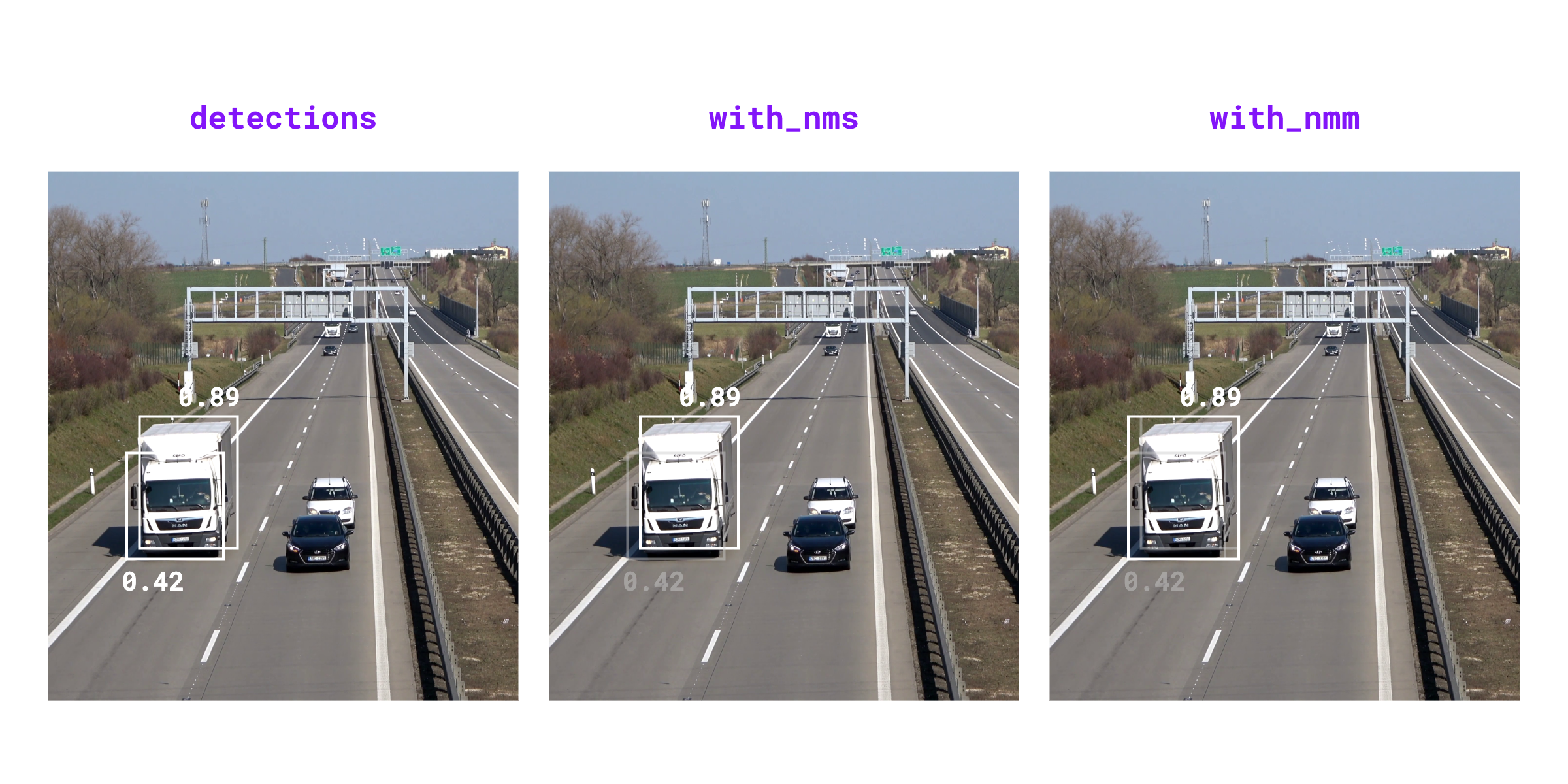{ align=center width="800" }
|
|
""" # noqa: E501 // docs
|
|
if len(self) == 0:
|
|
return self
|
|
|
|
assert self.confidence is not None, (
|
|
"Detections confidence must be given for NMM to be executed."
|
|
)
|
|
|
|
if class_agnostic:
|
|
predictions = cast(
|
|
npt.NDArray[np.floating],
|
|
np.hstack((self.xyxy, self.confidence.reshape(-1, 1))),
|
|
)
|
|
else:
|
|
assert self.class_id is not None, (
|
|
"Detections class_id must be given for NMM to be executed. If you"
|
|
" intended to perform class agnostic NMM set class_agnostic=True."
|
|
)
|
|
predictions = cast(
|
|
npt.NDArray[np.floating],
|
|
np.hstack(
|
|
(
|
|
self.xyxy,
|
|
self.confidence.reshape(-1, 1),
|
|
self.class_id.reshape(-1, 1),
|
|
)
|
|
),
|
|
)
|
|
|
|
if self.mask is not None:
|
|
merge_groups = mask_non_max_merge(
|
|
predictions=predictions,
|
|
masks=self.mask,
|
|
iou_threshold=threshold,
|
|
overlap_metric=overlap_metric,
|
|
)
|
|
elif ORIENTED_BOX_COORDINATES in self.data:
|
|
merge_groups = oriented_box_non_max_merge(
|
|
predictions=predictions,
|
|
oriented_boxes=np.asarray(
|
|
self.data[ORIENTED_BOX_COORDINATES], dtype=np.float32
|
|
),
|
|
iou_threshold=threshold,
|
|
overlap_metric=overlap_metric,
|
|
)
|
|
else:
|
|
merge_groups = box_non_max_merge(
|
|
predictions=predictions,
|
|
iou_threshold=threshold,
|
|
overlap_metric=overlap_metric,
|
|
)
|
|
|
|
result: list[Detections] = []
|
|
for merge_group in merge_groups:
|
|
group = [self.select(i) for i in merge_group]
|
|
result.append(_merge_detection_group(group))
|
|
|
|
return Detections.merge(result)
|
|
|
|
|
|
def _merge_obb_corners(
|
|
corners_list: list[npt.NDArray[np.floating]],
|
|
) -> npt.NDArray[np.floating]:
|
|
"""Merge multiple OBB corner arrays using winner-angle projection.
|
|
|
|
The first entry in *corners_list* is the winner. Its orientation angle
|
|
(derived from its first edge) defines the local frame in which the
|
|
tightest enclosing axis-aligned rectangle is computed. That rectangle is
|
|
then rotated back to produce the merged OBB.
|
|
|
|
Args:
|
|
corners_list: List of (4, 2) corner arrays. First is the winner.
|
|
|
|
Returns:
|
|
Merged OBB corners as a (4, 2) float32 array.
|
|
"""
|
|
all_corners = np.concatenate(corners_list, axis=0).astype(np.float32)
|
|
# Use winner's first edge to derive orientation angle -- avoids
|
|
# cv2.minAreaRect surprises (e.g. 90-degree flip for wide rects).
|
|
winner_edge = corners_list[0][1] - corners_list[0][0]
|
|
angle = float(np.arctan2(winner_edge[1], winner_edge[0]))
|
|
cos, sin = float(np.cos(angle)), float(np.sin(angle))
|
|
|
|
# De-rotate all corners into the winner's local frame
|
|
to_local = np.array([[cos, -sin], [sin, cos]], dtype=np.float32)
|
|
local_corners = all_corners @ to_local
|
|
x_min = float(local_corners[:, 0].min())
|
|
x_max = float(local_corners[:, 0].max())
|
|
y_min = float(local_corners[:, 1].min())
|
|
y_max = float(local_corners[:, 1].max())
|
|
|
|
# Rotate the enclosing AABB back to world frame
|
|
to_world = np.array([[cos, sin], [-sin, cos]], dtype=np.float32)
|
|
merged: npt.NDArray[np.floating] = (
|
|
np.array(
|
|
[[x_min, y_min], [x_max, y_min], [x_max, y_max], [x_min, y_max]],
|
|
dtype=np.float32,
|
|
)
|
|
@ to_world
|
|
)
|
|
return merged
|
|
|
|
|
|
def _merge_detection_group(detections: list[Detections]) -> Detections:
|
|
"""Merge a group of single-object Detections into one merged detection.
|
|
|
|
Used internally by :meth:`Detections.with_nmm` to combine each merge group
|
|
into a single output detection. The highest-confidence detection is the
|
|
"winner" whose class_id, tracker_id, and data fields are preserved.
|
|
|
|
Args:
|
|
detections: List of Detections, each containing exactly one object.
|
|
|
|
Returns:
|
|
A single merged Detections object of length 1.
|
|
"""
|
|
if len(detections) == 1:
|
|
return detections[0]
|
|
|
|
confidences = np.array(
|
|
[d.confidence[0] if d.confidence is not None else 0.0 for d in detections],
|
|
dtype=np.float64,
|
|
)
|
|
winner_idx = int(np.argmax(confidences))
|
|
winner = detections[winner_idx]
|
|
|
|
# Area-weighted confidence: each box contributes proportionally to its
|
|
# footprint so large overlapping boxes dominate over small slivers.
|
|
all_xyxy = np.array([d.xyxy[0] for d in detections], dtype=np.float32)
|
|
areas = (all_xyxy[:, 2] - all_xyxy[:, 0]) * (all_xyxy[:, 3] - all_xyxy[:, 1])
|
|
|
|
confidence: npt.NDArray[np.floating] | None
|
|
if winner.confidence is not None:
|
|
total_area = float(areas.sum())
|
|
if total_area > 0:
|
|
confidence = np.array(
|
|
[float(np.dot(areas, confidences) / total_area)],
|
|
dtype=np.float32,
|
|
)
|
|
else:
|
|
confidence = winner.confidence
|
|
else:
|
|
confidence = None
|
|
|
|
# OBB path: merge corners via winner-angle projection, then derive xyxy
|
|
# from the merged OBB so both stay consistent.
|
|
has_obb = ORIENTED_BOX_COORDINATES in winner.data
|
|
if has_obb:
|
|
corners_list = []
|
|
for det in detections:
|
|
c = np.asarray(det.data[ORIENTED_BOX_COORDINATES])
|
|
if c.ndim != 3 or c.shape[1:] != (4, 2):
|
|
raise ValueError(f"corners must have shape (N, 4, 2); got {c.shape}")
|
|
corners_list.append(c[0].reshape(4, 2))
|
|
merged_corners = _merge_obb_corners(corners_list)
|
|
xyxy = xyxyxyxy_to_xyxy(merged_corners[np.newaxis])
|
|
data = {**winner.data, ORIENTED_BOX_COORDINATES: merged_corners[np.newaxis]}
|
|
else:
|
|
# AABB path: union bounding box across all group members
|
|
xyxy = np.array(
|
|
[
|
|
[
|
|
all_xyxy[:, 0].min(),
|
|
all_xyxy[:, 1].min(),
|
|
all_xyxy[:, 2].max(),
|
|
all_xyxy[:, 3].max(),
|
|
]
|
|
],
|
|
dtype=np.float32,
|
|
)
|
|
data = winner.data
|
|
|
|
# Mask union via logical OR
|
|
masks = [d.mask for d in detections if d.mask is not None]
|
|
if masks:
|
|
mask = np.logical_or.reduce(np.concatenate(masks, axis=0))[np.newaxis]
|
|
else:
|
|
mask = None
|
|
|
|
metadata = merge_metadata([d.metadata for d in detections])
|
|
|
|
return Detections(
|
|
xyxy=xyxy,
|
|
mask=mask,
|
|
confidence=confidence,
|
|
class_id=winner.class_id,
|
|
tracker_id=winner.tracker_id,
|
|
data=data,
|
|
metadata=metadata,
|
|
)
|
|
|
|
|
|
@deprecated(deprecated_in="0.29.0", remove_in="0.32.0") # type: ignore[untyped-decorator]
|
|
def merge_inner_detection_object_pair(
|
|
detections_1: Detections, detections_2: Detections
|
|
) -> Detections:
|
|
"""
|
|
Merges two Detections objects into a single Detections object.
|
|
Assumes each Detections contains exactly one object.
|
|
|
|
A `winning` detection is determined based on the confidence score of the two
|
|
input detections. This winning detection is then used to specify which
|
|
`class_id`, `tracker_id`, and `data` to include in the merged Detections object.
|
|
|
|
The resulting `confidence` of the merged object is calculated by the weighted
|
|
contribution of each detection to the merged object.
|
|
The bounding boxes and masks of the two input detections are merged into a
|
|
single bounding box and mask, respectively.
|
|
|
|
Args:
|
|
detections_1: The first Detections object.
|
|
detections_2: The second Detections object.
|
|
|
|
Returns:
|
|
A new Detections object, with merged attributes.
|
|
|
|
Raises:
|
|
ValueError: If the input Detections objects do not have exactly 1 detected
|
|
object.
|
|
|
|
Example:
|
|
```python
|
|
import cv2
|
|
import supervision as sv
|
|
from inference import get_model
|
|
|
|
image = cv2.imread("<SOURCE_IMAGE_PATH>")
|
|
model = get_model(model_id="yolov8s-640")
|
|
|
|
result = model.infer(image)[0]
|
|
detections = sv.Detections.from_inference(result)
|
|
|
|
merged_detections = merge_object_detection_pair(
|
|
detections[0], detections[1])
|
|
```
|
|
"""
|
|
if len(detections_1) != 1 or len(detections_2) != 1:
|
|
raise ValueError("Both Detections should have exactly 1 detected object.")
|
|
|
|
_validate_fields_both_defined_or_none(detections_1, detections_2)
|
|
|
|
xyxy_1 = detections_1.xyxy[0]
|
|
xyxy_2 = detections_2.xyxy[0]
|
|
if detections_1.confidence is None and detections_2.confidence is None:
|
|
merged_confidence = None
|
|
else:
|
|
assert detections_1.confidence is not None
|
|
assert detections_2.confidence is not None
|
|
detection_1_area = (xyxy_1[2] - xyxy_1[0]) * (xyxy_1[3] - xyxy_1[1])
|
|
detections_2_area = (xyxy_2[2] - xyxy_2[0]) * (xyxy_2[3] - xyxy_2[1])
|
|
merged_confidence = (
|
|
detection_1_area * detections_1.confidence[0]
|
|
+ detections_2_area * detections_2.confidence[0]
|
|
) / (detection_1_area + detections_2_area)
|
|
merged_confidence = np.array([merged_confidence])
|
|
|
|
merged_x1, merged_y1 = np.minimum(xyxy_1[:2], xyxy_2[:2])
|
|
merged_x2, merged_y2 = np.maximum(xyxy_1[2:], xyxy_2[2:])
|
|
merged_xyxy = np.array([[merged_x1, merged_y1, merged_x2, merged_y2]])
|
|
|
|
if detections_1.mask is None and detections_2.mask is None:
|
|
merged_mask = None
|
|
else:
|
|
merged_mask = np.logical_or(
|
|
cast(npt.NDArray[Any], detections_1.mask),
|
|
cast(npt.NDArray[Any], detections_2.mask),
|
|
)
|
|
|
|
if detections_1.confidence is None or detections_2.confidence is None:
|
|
winning_detection = detections_1
|
|
elif detections_1.confidence[0] >= detections_2.confidence[0]:
|
|
winning_detection = detections_1
|
|
else:
|
|
winning_detection = detections_2
|
|
|
|
metadata = merge_metadata([detections_1.metadata, detections_2.metadata])
|
|
|
|
return Detections(
|
|
xyxy=merged_xyxy,
|
|
mask=merged_mask,
|
|
confidence=merged_confidence,
|
|
class_id=winning_detection.class_id,
|
|
tracker_id=winning_detection.tracker_id,
|
|
data=winning_detection.data,
|
|
metadata=metadata,
|
|
)
|
|
|
|
|
|
@deprecated(deprecated_in="0.29.0", remove_in="0.32.0") # type: ignore[untyped-decorator]
|
|
def merge_inner_detections_objects(
|
|
detections: list[Detections],
|
|
threshold: float = 0.5,
|
|
overlap_metric: OverlapMetric = OverlapMetric.IOU,
|
|
) -> Detections:
|
|
"""
|
|
Given N detections each of length 1 (exactly one object inside), combine them into a
|
|
single detection object of length 1. The contained inner object will be the merged
|
|
result of all the input detections.
|
|
|
|
For example, this lets you merge N boxes into one big box, N masks into one mask,
|
|
etc.
|
|
"""
|
|
detections_1 = detections[0]
|
|
for detections_2 in detections[1:]:
|
|
if detections_1.mask is not None and detections_2.mask is not None:
|
|
iou = mask_iou_batch(detections_1.mask, detections_2.mask, overlap_metric)[
|
|
0
|
|
]
|
|
else:
|
|
iou = box_iou_batch(
|
|
detections_1.xyxy,
|
|
detections_2.xyxy,
|
|
overlap_metric,
|
|
)[0]
|
|
if iou < threshold:
|
|
break
|
|
detections_1 = merge_inner_detection_object_pair(detections_1, detections_2)
|
|
return detections_1
|
|
|
|
|
|
@deprecated(deprecated_in="0.29.0", remove_in="0.32.0") # type: ignore[untyped-decorator]
|
|
def merge_inner_detections_objects_without_iou(
|
|
detections: list[Detections],
|
|
) -> Detections:
|
|
"""
|
|
Given N detections each of length 1 (exactly one object inside), combine them into a
|
|
single detection object of length 1. The contained inner object will be the merged
|
|
result of all the input detections.
|
|
|
|
For example, this lets you merge N boxes into one big box, N masks into one mask,
|
|
etc.
|
|
"""
|
|
return reduce(merge_inner_detection_object_pair, detections)
|
|
|
|
|
|
def _validate_fields_both_defined_or_none(
|
|
detections_1: Detections, detections_2: Detections
|
|
) -> None:
|
|
"""
|
|
Verify that for each optional field in the Detections, both instances either have
|
|
the field set to None or both have it set to non-None values.
|
|
|
|
`data` field is ignored.
|
|
|
|
Raises:
|
|
ValueError: If one field is None and the other is not, for any of the fields.
|
|
"""
|
|
attributes = get_instance_variables(detections_1)
|
|
for attribute in attributes:
|
|
value_1 = getattr(detections_1, attribute)
|
|
value_2 = getattr(detections_2, attribute)
|
|
|
|
if (value_1 is None) != (value_2 is None):
|
|
raise ValueError(
|
|
f"Field '{attribute}' should be consistently None or not None in both "
|
|
"Detections."
|
|
)
|
|
|
|
|
|
@deprecated( # type: ignore[untyped-decorator]
|
|
target=_validate_fields_both_defined_or_none,
|
|
deprecated_in="0.29.0",
|
|
remove_in="0.32.0",
|
|
)
|
|
def validate_fields_both_defined_or_none(
|
|
detections_1: Detections, detections_2: Detections
|
|
) -> None:
|
|
void(detections_1, detections_2)
|