 f30d59b989
* feat(docs): add SchemaSnapshot model * feat(docs): infer relationship cardinality from foreign keys * fix(docs): resolve foreign keys within the source schema * feat(docs): convert group hue to sRGB hex for DBML * feat(docs): add DBML lexical primitives * feat(docs): render DBML table blocks * feat(docs): render DBML refs, enums and table groups * feat(docs): assemble complete DBML documents * feat(docs): collect schema snapshots with bounded fan-out * fix(docs): gate FK warning on engine capability and reference synthesized enums * fix(docs): qualify synthesized enum references in multi-schema output * test(docs): anchor the multi-schema enum reference assertion * feat(docs): add snapshot collection route * feat(docs): add collect_docs_snapshot to DbxBackend * feat(docs): add dbx dbml command * test(docs): add live snapshot and DBML verification Runs collect_snapshot + to_dbml against a real PostgreSQL database (organon, 47 tables) and asserts structural DBML validity: Project header, every table present, balanced braces, trailing newline. * refactor(docs): use sort_by_key for snapshot table ordering * docs(docs): add database documentation design and implementation plan Records the Part 1 design (SchemaSnapshot + DBML export) and the plan that produced it. The plan carries an appendix listing the thirteen assumptions that proved wrong during execution, so the corrected facts are not re-derived from the surrounding prose. Co-Authored-By: Claude Opus 5 (1M context) <noreply@anthropic.com> Claude-Session: https://claude.ai/code/session_01TKcC15gEuQBHMidPCFFYwn * fix(docs): use native enum names, canonical engine labels, and surface metadata failures Final review fix wave covering four findings: - PostgreSQL named enums (e.g. `ConversationStatus`) now keep their own type name and synthesized: false, instead of being renamed to `{table}_{column}` and losing identity. A type shared by several columns now dedupes to a single Enum block instead of colliding or duplicating. `synthesize_enum` and `render_type` route through one shared `enum_type_name` helper so the two can't drift apart again. - `database_type` (and the CommentsUnsupported/NoForeignKeyMetadata warnings) now use the same canonical engine label already used throughout table_structure_sql's own warning prose, instead of a raw Rust Debug string (`Postgres`, `SqlServer`, `MongoDb`). - An index-fetch failure during collection now surfaces as a TableSkipped warning instead of silently degrading to an empty index list, which relations.rs uses to infer relationship cardinality. - A schema-enumeration failure now surfaces as a warning instead of silently proceeding against schema "". - Removed the redundant Arc<Semaphore>; buffer_unordered already caps concurrency at MAX_CONCURRENT_TABLES. Co-Authored-By: Claude Opus 5 (1M context) <noreply@anthropic.com> Claude-Session: https://claude.ai/code/session_01TKcC15gEuQBHMidPCFFYwn * feat(docs): add annotation file model * test(docs): assert full round-trip fidelity for the annotation model * feat(docs): add per-engine annotation key folding * fix(docs): do not fold identifiers on case-sensitive engines * feat(docs): load and validate the notes file * fix(docs): report a version mismatch before unknown-field errors * feat(docs): merge annotations into the schema snapshot * feat(docs): detect orphaned annotations without deleting them * feat(docs): add --notes to dbx dbml * feat(docs): remember a notes file path per connection Adds docs_notes_path to ConnectionConfig so the desktop app (Part 3) can persist where a connection's documentation notes file lives. The CLI is unaffected — it takes an explicit --notes path. ConnectionConfig has a hand-written Deserialize impl that delegates to a mirror struct, ConnectionConfigData, and converts via From. Adding the field only to ConnectionConfig would compile but never populate from stored JSON, since ConnectionConfigData's fields are what serde actually reads. The field is threaded through all three places: ConnectionConfig, ConnectionConfigData, and the From impl, mirroring the existing `color` field. * test(docs): verify annotations against a live database * test(docs): assert exactly one orphaned annotation * feat(docs): add snapshot types for the docs viewer * fix(docs): correct snapshot type nullability and add missing column fields * feat(docs): add a real-output fixture and drift conformance test The fixture is generated by dump_docs_fixture.rs from a live collect_snapshot run against the keycloak database in the shared local-infra stack, with annotations applied so a LOCAL note, column note, group and orphanedNotes warning are all present. fixtureConformance.spec.ts asserts against that real JSON rather than a hand-written literal, so a change to the Rust snapshot shape breaks the test instead of silently drifting from the hand-maintained types.ts. Keycloak is used because its schema is public open-source knowledge, so the committed fixture carries no private schema. The kept tables are an explicit allowlist rather than an alphabetical slice, because the conformance test needs a connected foreign-key subgraph: protocol_mapper has two foreign keys to different tables and composite_role has two to the same one. * feat(docs): add index grouping for the docs viewer * feat(docs): describe snapshot warnings for the viewer * feat(docs): add client-side search for the docs viewer * test(docs): make the search fixture able to fail * feat(docs): expose group hue as a CSS custom property * docs(plan): add annotations and viewer plans, correct Task 7 Parts 2 and 3a were planned after the first plan was committed and were never tracked. docs/superpowers/ is gitignored, so both needed -f, matching how the existing specs and plans in that directory were added. The viewer plan's Task 7 is corrected against the installed marked@18.0.4. Its original text carried four defects, found by probing the library rather than by review: an assertion that fails against a correct implementation, a pre-escaping approach that double-escapes entities, a javascript: blocklist with live bypasses (entity-encoded, vbscript:, data:text/html, and <img src>, which was never covered at all), and a link renderer whose text property is raw markdown source rather than parsed HTML — an XSS hole found while verifying the fix for the previous defect. The viewer plan also gains a corrections appendix grouping defects by failure mode. The annotations plan is committed as written; its defects are recorded in a follow-up. * feat(docs): render note markdown with raw HTML escaped * fix(docs): drop protocol-relative URLs in note markdown The URL allowlist permitted anything starting with / so relative paths work, and //evil.com qualifies. Over https that grants nothing a note author could not do with an ordinary https link, but the Part 3b standalone export is opened via file://, where //host/path is a UNC path. On Windows that opens an SMB connection and leaks an NTLM hash, with no click required since images auto-load, and it is plantable from a COMMENT ON value. Found by an adversarial probe of the committed module rather than by review; the backslash form was already dropped, only the slash form slipped through. * docs(plan): add corrections appendix to the annotations plan Groups the defects found executing Part 2 by failure mode, matching the form of the viewer plan's appendix. The notable one is Mode A: docs_notes_path had to be added in three places because ConnectionConfig has a serde mirror struct, and adding it in one place compiles, passes a round-trip test written against the same struct, and then reads None forever after every load. Also records a controller hypothesis that turned out to be wrong, since checking it cost one read. * fix(docs): reject backslash protocol-relative URLs in notes The // guard from the previous commit was itself a blocklist: /\evil.com starts with a single slash, so it passed, and the WHATWG URL spec treats /\ identically to // for special schemes. Browsers normalise the backslash, so it reaches the same file:// UNC path and the same no-click NTLM leak. Rejecting both separator characters in both positions closes it. Found by probing what String(raw).trim() leaves unnormalised before the prefix checks; the third defect on this file found by probing rather than by reading. * feat(docs): add docs viewer components Co-Authored-By: Claude Opus 5 (1M context) <noreply@anthropic.com> Claude-Session: https://claude.ai/code/session_01TKcC15gEuQBHMidPCFFYwn * test(docs): pin each theme's legacy colour base independently The ordering check indexOf(hsl) < indexOf(@supports) quantified over any occurrence, so deleting the light .docs-group block left the dark block's hsl satisfying it. The test passed while every table group rendered colourless on light-theme WebViews without oklch. Asserting each selector's own base block catches deleting either one. Found by the task implementer, which deleted one block and then both to show the guard pinned 'some base exists' rather than 'each selector has a base'. * fix(docs): escape single quotes in note attribute values escapeHtml covered & < > and double quotes but not single quotes. Not exploitable today because every attribute in this file is double-quoted, but that is a formatting convention enforced nowhere and living in a different part of the file from the escaper. A future edit writing title='...' would turn a formatting choice into an attribute breakout. Raised by review as latent fragility rather than a defect; fixed because the escaper should be correct on its own rather than correct-given-an-invariant. * test(docs): match single-quoted v-html bindings in the contract guard The guard matched /v-html\s*=\s*"([^"]*)"/ — double quotes only. A binding written `v-html='table.note'` produced zero matches and passed, handing a database COMMENT ON value straight to the DOM with the renderNote sanitiser bypassed. Both quote styles are valid Vue and nothing in the repo enforces one, so the guard had a hole exactly where it mattered most. Verified by temporarily rewriting a real WikiIndex binding as `v-html='table.note'`: the test now fails with "WikiIndex.vue: v-html must render renderNote output: expected 'table.note' to contain 'renderNote'". Co-Authored-By: Claude Opus 5 (1M context) <noreply@anthropic.com> Claude-Session: https://claude.ai/code/session_01TKcC15gEuQBHMidPCFFYwn * fix(docs): cap search results per kind instead of overall DocsSearch sliced searchDocs output to 40 AFTER concatenation, and the concatenation order is tables -> columns -> groups -> enums. Columns always flooded the list, so the cap deleted the tail — every group and enum hit. Against the real fixture, "e" produced 155 hits (9 table, 133 column, 1 group, 12 enum) and rendered 9 tables, 31 columns and nothing else; groups and enums were structurally unreachable through search. Cap each kind against its own limit inside docsSearch.ts, where the logic is tested, and drop the slice from the template so exactly one place limits results. Ranking is unchanged: tables still precede columns. Verified by reverting to a single .slice(0, 40) over the concatenation: the new tests fail with "enums must survive a column flood: expected false to be true" and "expected 30 to be 20". Co-Authored-By: Claude Opus 5 (1M context) <noreply@anthropic.com> Claude-Session: https://claude.ai/code/session_01TKcC15gEuQBHMidPCFFYwn * fix(docs): move the index card note out of its button The card rendered renderNote output with v-html inside the <button>. A note containing a markdown link — [spec](https://example.com) — put an <a> inside a <button>: invalid nesting, and the anchor was not keyboard reachable because the button swallows it in the tab order. The <li> now carries the card's border, background and hover, the button holds only the table name and kind, and the note is its sibling. Visually identical — same padding, same 0.5 gap, previously mt-0.5 — and the name row still spans the full width as the click target. Co-Authored-By: Claude Opus 5 (1M context) <noreply@anthropic.com> Claude-Session: https://claude.ai/code/session_01TKcC15gEuQBHMidPCFFYwn * test(docs): pin every fixture struct's key set in both directions The guard pinned ColumnInfo and IndexInfo plus three DocTable keys, and only in the "no missing key" direction. Relationship, FieldRef, DocEnum, ProjectMeta, ColumnNote, ForeignKeyInfo, TableGroup and 10 of 13 DocTable keys were unchecked. Renaming Relationship::to to `target` in Rust kept the suite at 67/67 and vue-tsc at exit 0 while RelationshipList read `field.table` on undefined and every table page rendered blank. Every struct in the fixture is now pinned both ways — no missing key, no unexpected key — over every instance rather than element [0]. Each direction catches a different half of a rename. Object.hasOwn throughout, so a key that is present and null stays distinguishable from one skip_serializing_if omitted. ForeignKeyInfo, TableGroup and the SchemaSnapshot root are included beyond the list the review gave: they are equally present in the fixture and equally unpinned. Verified against a modified copy of the fixture outside the repo with Relationship::to renamed: "Relationship[0] must always carry to: expected false to be true". Co-Authored-By: Claude Opus 5 (1M context) <noreply@anthropic.com> Claude-Session: https://claude.ai/code/session_01TKcC15gEuQBHMidPCFFYwn * fix(cli): error when an explicit --notes path does not exist load_annotations returns Ok(None) for a missing file, which is right for the implicit per-connection notes path — it may legitimately not exist yet. It is wrong for --notes, where the user named a specific file: a mistyped path produced DBML with every note silently absent and no diagnostic at all, indistinguishable from a database that has no documentation. Both final reviewers independently ruled this must-fix-before-merge. * fix(docs): treat an explicit FK ref_schema as authoritative find_target tried the explicit ref_schema, then fell through to the source table's own schema on failure. When the referenced schema was not collected — routine, since users select schemas — an FK from sales.orders to archive.customers resolved to sales.customers instead: a different table, and a diagram that is confidently wrong rather than visibly incomplete. The function's own doc comment already promised that keys pointing outside the collected set are dropped. Now it does that. This is a regression of the defect found in Part 1: the three-tier lookup was added then, but tier one was written to fall through rather than to decide. * fix(docs): corroborate engine capability warnings against what was collected supports_comments and supports_foreign_keys delegate to the structure editor's DDL-generation capabilities, not to introspection support. IRIS is the proven divergence: it reports %DESCRIPTION on introspection but DBX cannot ALTER an existing one, so the flag is false while the collector reads and includes those comments — producing a snapshot that warned comments were unsupported alongside the comments themselves. Each warning now fires only when the flag says the engine cannot AND collection found nothing of the kind to contradict it. ClickHouse and Doris, which genuinely report no foreign keys, still warn. The doc comments now say what the functions actually measure. Found by final review, which traced every other caller to establish the flag's real semantics. * docs(fixture): finish repointing the fixture source to keycloak Follows the rebase that replaced the fixture at its origin commit. Repoints the live annotation test's project identity and both plans, and records the one capability keycloak costs us. Keycloak declares no PostgreSQL enum types, so the fixture cannot exercise DocEnum — a Rust-side rename of a DocEnum field would pass every test here and break the viewer's enum rendering silently. Rather than delete the test, it now asserts the gap, so it fails the day the fixture source gains an enum and prompts restoring the pin. * docs(spec): design for in-app database documentation (Part 3b) Mounts the Part 3a viewer in DBX and makes it editable: table/column notes, table groups, and per-group colour, autosaved to a notes file that can live in the user's repository. Two findings shaped the scope. DBX already ships SchemaDiagramDialog, so the viewer links to it rather than building a second ER diagram — only the Part 3c export needs its own minimal renderer, because that dialog reaches into stores and cannot be inlined. And nothing currently reads docs_notes_path or writes annotations at all, so 'in-app editing' needs new Rust rather than frontend wiring alone. The standalone export, dbx docs verb and hash routing are deferred to 3c. * docs(plan): implementation plan for in-app database documentation Ten tasks: atomic annotation save and path resolution, Tauri commands, web route parity, the frontend facade, pure edit transforms, the i18n namespace with a parity guard, editing components, the enum page, edit plumbing through the viewer, and the dialog with debounced autosave. Self-review caught three defects before dispatch, all the same class that cost Part 3a ten fix rounds: a return type named DescribedWarning that does not exist (it is WarningNotice), a test calling emptySnapshot() which does not exist, and a table() helper invoked with columns when its real signature takes a groupId. Every identifier the plan names is a claim about the codebase. * docs(plan): resolve the data directory without a dbx-mcp dependency Tasks 2 and 3 called dbx_mcp::paths::app_data_dir(), but neither src-tauri nor dbx-web depends on dbx-mcp, so neither would have compiled. Both already have a better source: AppState.storage.data_dir() honours a custom data dir, and WebState already carries data_dir. Found by the pre-flight scan before any implementer saw it. * docs(plan): fix Task 1 against the real crate (no Default, no tempfile) ConnectionConfig has no Default derive and ~60 fields, so resolve_notes_path now takes the connection id and the optional override directly — the two fields it actually reads. The test pain was pointing at the signature. dbx-core has no dev-dependencies, so the tests use the temp_dir + uuid idiom already present in annotations.rs rather than tempfile. * feat(docs): add atomic annotation save and notes path resolution * docs(plan): guard the autosave against concurrent writes flush() cleared the debounce timer but not an in-flight write, so closing the dialog while a debounced save was awaiting the backend started a second one. Two concurrent saves of the same file waste a round trip, race to land stale, and are the exact concurrency that corrupts the notes file when the temp path is not unique per writer. Found while adjudicating the Task 1 review, which demonstrated the Rust half of the same problem. * fix(docs): make temp paths unique to prevent concurrent save corruption * fix(docs): replace vacuous atomicity test with inode-based verification * docs(plan): correct the apply_annotations import path dbx_core::docs re-exports collector, color, dbml, keys, relations and snapshot but NOT annotations, so apply_annotations and friends are only reachable at dbx_core::docs::annotations. Tasks 2 and 3 both used the shorter path and would not have compiled. Verified against crates/dbx-core/src/docs/mod.rs before either was dispatched. * fix(docs): truncate temp filename to stay within 255-byte filesystem limit * feat(docs): add Tauri commands for docs snapshot and annotations * docs(plan): propagate the resolve_notes_path signature to its callers Pre-flight changed resolve_notes_path to take (connection_id, docs_notes_path, data_dir) instead of a ConnectionConfig, but only Task 1 was updated. Tasks 2 and 3 still called it with the old signature and would not have compiled. The Task 2 implementer caught it and used the correct form from its dispatch note. Task 3 had the identical stale call and had not been dispatched yet. The plan's self-review checks signature consistency across tasks; this changed AFTER that review, during pre-flight, and nothing re-ran the check. * docs(plan): pin Task 4's http.ts idiom and the Tauri argument names http.ts uses a post<T>(url, body) helper at line 222; the plan said only 'match the existing idiom', which is delegating verification to someone with less context. Written out concretely now. Also records what Task 2's review flagged as unverifiable from its own diff: Tauri serialises command arguments by name, so the invoke object keys must match the Rust parameter names. That mismatch compiles cleanly on both sides and fails only when a user clicks — and it falls in the gap between two task-scoped reviews, since neither diff contains both halves. * feat(docs): add web routes for annotation load, apply and save Mirrors the Tauri commands (docs_load_annotations, docs_apply_annotations, docs_save_annotations) added in the previous task: collect returns the raw snapshot, apply is separate so the shadowedNote rule stays in one place. * docs(plan): make the i18n parity guard actually observable Every non-English locale is export default withEnglishFallback({...}) — the fallback is applied at module level, inside the locale file. Only en.ts is a bare object. So importing a locale's default export yields the ALREADY-MERGED object, and the parity test would have found every key present in every locale and passed while translations were missing. The test written to catch silent English fallback would have been silently defeated by that fallback. Task 6 now puts the new namespace in per-locale modules under locales/docs/, which the test imports directly and unwrapped. Scoped entirely to the new namespace; the existing 315 KB of keys are untouched. Step 6 also asks the implementer to demonstrate the trap: point the imports back at the merged modules and watch a missing key pass. * feat(docs): expose docs snapshot and annotations to the frontend * docs(plan): locate the duplicated table-key rule correctly in Task 8 The plan said docsIndex.ts builds the qualified table key inline. It does not — it groups by table.schema, a section key. The table key rule lives in a private qualified() in docsSearch.ts and in a hand-rolled tableKey() in DocsApp.vue, DocsSidebar.vue and WikiIndex.vue. Part 3a's final review flagged that duplication as a Minor and it was deferred. Task 8 was about to add a fifth copy, so it now extracts docsKeys.ts first and replaces the existing ones. This is the key annotations are stored under, so two call sites disagreeing attaches a note to the wrong table. * feat(docs): add pure annotation edit transforms * docs(plan): ground the group hue picker in DBX's existing swatch idiom ConnectionDialog.vue already has a swatch row — h-6 w-6 rounded-full buttons, ring-2 selected state, i18n titles. Task 7 now points at it so the new picker looks native. With an explicit warning not to copy the fill mechanism: connection colours are hex painted via Tailwind classes, group colours are hues rendered through docs.css. A naive copy introduces hex literals and fails the contract test — correctly, since a hardcoded hex cannot stay legible on both grounds, which is why groups store a hue at all. * docs(plan): make Task 10's dialog wiring concrete Five exact locations, all verified: the store ref and its export, the useDialogSources watcher, the AppDialogs import and render, and the ObjectBrowser trigger plus its context-menu entry. Records the non-obvious part: the watcher clears the source back to null after firing, and that clearing is what makes the dialog re-openable — without it, setting the same value twice does not re-trigger the watch. ObjectBrowser is the entry point rather than the connection tree, because the tree has no diagram entry either and ObjectBrowser already supplies exactly the prefills the docs dialog needs. * feat(docs): add the docs i18n namespace with a parity guard * fix(docs): ban vue-i18n from standalone-exportable docs components WarningBanner.vue used useI18n() directly, which throws with no Vue app instance -- exactly the standalone HTML export case describeWarning's translator parameter exists to avoid. Thread translate as a prop from DocsApp instead, and add vue-i18n/useI18n( to the component contract's forbidden list so the constraint is enforced, not just documented. * docs(plan): note that DocsApp already has snapshot and translate Task 6's fix added translate to DocsApp when describeWarning started taking a translator. Task 9 said to add it, which would have been a duplicate prop. It now says to add only annotations and readonly to the existing defineProps. * feat(docs): add note editor, group editor and group picker * docs(plan): give Task 10 the dialog shell from SchemaDiagramDialog Exact Dialog primitives, the get/set computed every dialog here uses to bridge the open prop, and the sizing class copied verbatim from SchemaDiagramDialog.vue:827 — the docs viewer is the same kind of full-window workspace, not a form, so it should not invent dimensions. Also states explicitly that this component lives outside src/docs/ and so may and must use useI18n(): it is what supplies the translate prop the viewer components need, since they are banned from importing vue-i18n themselves. * test(docs): guard the light-ground group tokens too * feat(docs): add the enum page and a shared table-key helper EnumPage renders an enum's values and every column declared with that type. It is read-only on purpose: AnnotationFile has no `enums` key, so an edited note would have nowhere to be saved. qualifiedTableKey moves the `schema.name` rule — bare name on schema-less engines like SQLite and MySQL — into docsKeys, where the call sites that had each copied it can share one definition. It is the key annotations are stored under, so two call sites disagreeing would attach a note to the wrong table. columnsUsingEnum matches data_type exactly rather than by substring: an enum named `state` would otherwise claim every `estado` and `statement` column. Co-Authored-By: Claude Opus 5 (1M context) <noreply@anthropic.com> Claude-Session: https://claude.ai/code/session_01VTBWnT4goXLA9iqDrfTPqk * refactor(docs): share one qualified table key across the viewer Six call sites had each copied the `schema.name` rule; they now import qualifiedTableKey from docsKeys instead. Two were not in the plan's list: TablePage.vue and RelationshipList.vue. RelationshipList passes a remapped FieldRef rather than a DocTable, which is why the helper takes Pick<DocTable, "schema" | "name"> — that widening is what let every call site be adapted directly instead of keeping a thin delegating wrapper. Also strengthens the columnsUsingEnum substring guard, which was not guarding anything. Its only column had type `integer`, and "integer".includes("state") is false, so replacing the exact match with includes() left all 8 tests green. Adds a `statement` column — the only type here that really contains `state` — and drops `estado` from the doc comment, since it does not. Co-Authored-By: Claude Opus 5 (1M context) <noreply@anthropic.com> Claude-Session: https://claude.ai/code/session_01VTBWnT4goXLA9iqDrfTPqk * feat(docs): thread editing through the viewer as emitted events DocsApp gains `annotations` and `readonly` and re-emits a DocsEdit for every change its children request. Nothing under src/docs/ persists anything, which is what keeps the directory bundleable into the standalone HTML export; a new contract guard now pins that by rejecting any component that names save/load/applyDocsAnnotations. NoteEditor is fed the MERGED snapshot note, not the local annotation layer. It renders and edits one value, so seeding it locally would show nothing for a note that came from a database comment. Writing over one shadows it, which is what noteSource and shadowedNote already exist to disclose. `annotations` is threaded for what the merge erases: `groups` carries the editable GroupAnnotation records, while snapshot.groups carries resolved TableGroups that GroupPicker and GroupEditor cannot write back to. Also makes enums reachable. EnumPage rendered nowhere and search returned enum hits that DocsSearch deliberately disabled, since enums carry no table key; they now navigate by bare name, which is how columnsUsingEnum resolves them too. Groups remain unclickable — they still have no page. Co-Authored-By: Claude Opus 5 (1M context) <noreply@anthropic.com> Claude-Session: https://claude.ai/code/session_01VTBWnT4goXLA9iqDrfTPqk * feat(docs): mount the documentation viewer in DBX with autosaved editing DatabaseDocsDialog hosts DocsApp outside src/docs/, which is what lets it use useI18n() and supply the `translate` prop the viewer components are banned from importing for themselves. It collects the snapshot, loads the notes file (falling back to emptyAnnotations), and holds the raw snapshot so every edit can re-derive the merged view through applyDocsAnnotations. createAutosave debounces writes and, above all, makes a failure visible: a silently swallowed write is the worst outcome here, because the user keeps typing and believes their notes are saved. It also refuses to run two writes at once — flush() clearing the timer does not stop a write already awaiting save, and two concurrent writes of the same file is the exact race that corrupted the notes file before the Rust side used a unique temp path. Both properties are pinned by tests I confirmed fail when the guard is removed. Loads and re-derivations carry a generation number so a slow response cannot overwrite a newer one, and closing flushes the debounce rather than dropping a note typed a moment earlier. Trigger mirrors the schema diagram's wiring: docsSource on connectionStore, a watch in useDialogSources that clears the source so the dialog is re-openable, an async component in AppDialogs, and openDocs in ObjectBrowser. The context entry is added at BOTH object menus — the plan named only the table one, but views offer diagram.open too and documentation is no less relevant there. Co-Authored-By: Claude Opus 5 (1M context) <noreply@anthropic.com> Claude-Session: https://claude.ai/code/session_01VTBWnT4goXLA9iqDrfTPqk * docs(plan): record Tasks 1-10 as done The plan carried 58 unticked boxes after ten completed tasks, so progress had to be reconstructed from the commit trail instead of read off the document. Tasks 1-7 are ticked from that commit evidence rather than from step-by-step observation — they landed in earlier sessions. Tasks 8-10 were executed and verified directly. Task 8 Step 2 stays open on purpose. `columnsUsingEnum` was already implemented and committed before that step was reached, so its failure was never observed; the exact-match guard was verified by Step 5 instead, which is what exposed that the test could not detect a substring match at all. Co-Authored-By: Claude Opus 5 (1M context) <noreply@anthropic.com> Claude-Session: https://claude.ai/code/session_01VTBWnT4goXLA9iqDrfTPqk * feat(docs): print snapshot warnings as prose from the CLI `dbx dbml` printed `{warning:?}`, so a skipped table surfaced as `TableSkipped { table: "public.orders", reason: "permission denied" }` — the struct shape, reading like a panic rather than like advice. The prose lives in Rust rather than in the `docs.warnings` i18n namespace because the CLI has no i18n runtime. That is the same constraint that made `describeWarning` take a translator instead of importing vue-i18n: the viewer translates, the CLI cannot, so each needs its own source for the same text. A second test asserts the rendering is not the Debug form, because reverting the CLI to `{warning:?}` is a one-character edit that still compiles and still prints something. Co-Authored-By: Claude Opus 5 (1M context) <noreply@anthropic.com> Claude-Session: https://claude.ai/code/session_01Ro4mfGEmsbbH32WYsvxsfH * feat(docs): let a connection point its notes file at a repository `docs_notes_path` has existed on `ConnectionConfig` since Part 2 and has been read by `resolve_notes_path` since Part 3b, but nothing ever set it — so every connection silently used the app data directory default and the override was unreachable. The field is what makes schema documentation reviewable: pointing it at a file inside a repository puts notes in the same diff as the migration that changed the schema. Gated on `isSchemaAware`, matching the row above it, since documentation is a relational-only feature. A cleared field is normalised to absent rather than "" — `resolve_notes_path` treats blank as unset, but an empty string would still be persisted as though a path had been chosen. Co-Authored-By: Claude Opus 5 (1M context) <noreply@anthropic.com> Claude-Session: https://claude.ai/code/session_01Ro4mfGEmsbbH32WYsvxsfH * docs: document database documentation and DBML export Covers opening the viewer, notes and groups, the LOCAL/database-comment rule, the notes file format and where it lives, every warning the viewer can raise, and the `dbx dbml` verb including the CI drift check. States the boundaries explicitly — relational engines only, no triggers or procedures, and DBML export is one-way — because each of those is a question the feature invites and would otherwise be answered by trying it. Co-Authored-By: Claude Opus 5 (1M context) <noreply@anthropic.com> Claude-Session: https://claude.ai/code/session_01Ro4mfGEmsbbH32WYsvxsfH --------- Co-authored-by: Claude Opus 5 (1M context) <noreply@anthropic.com> Co-authored-by: t8y2 <t8y2@users.noreply.github.com> |
||
|---|---|---|
| .cargo | ||
| .github | ||
| .husky | ||
| agents | ||
| apps | ||
| crates | ||
| deploy | ||
| docs | ||
| examples | ||
| packages | ||
| plugins | ||
| scripts | ||
| skills/dbx | ||
| src-tauri | ||
| tests/fixtures | ||
| vendor | ||
| .gitattributes | ||
| .gitignore | ||
| .nvmrc | ||
| .oxfmtrc.json | ||
| CONTRIBUTING.md | ||
| CONTRIBUTING.zh-CN.md | ||
| Cargo.lock | ||
| Cargo.toml | ||
| LICENSE | ||
| Makefile | ||
| README-NIX.md | ||
| README.md | ||
| README.zh-CN.md | ||
| SECURITY.md | ||
| clippy.toml | ||
| dbx-er-diagram-architecture.html | ||
| flake.lock | ||
| flake.nix | ||
| handoff.md | ||
| package.json | ||
| pnpm-lock.yaml | ||
| pnpm-workspace.yaml | ||
| rustfmt.toml | ||
| vitest.config.ts | ||
README.md
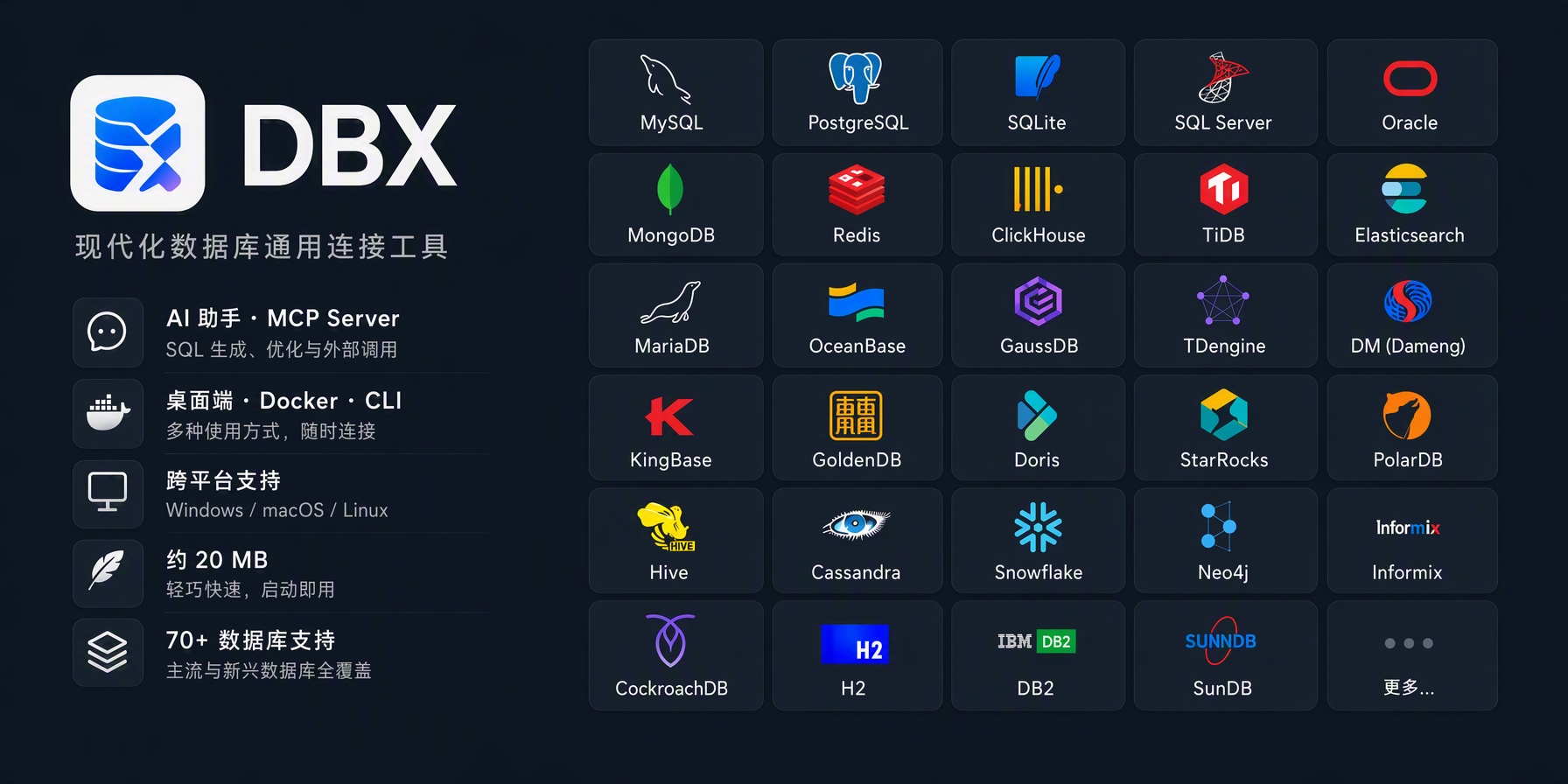
70+ databases in 20 MB. Desktop, Docker, CLI, built-in AI assistant, and MCP Server.








English | 前往中文版本
Why DBX?
🪶 20 MB, zero runtime bloatNo Java JRE. No Python venv. No bundled Chromium. DBX ships as a single small binary — download, install, connect. DBeaver needs Java; TablePlus is macOS-only. DBX runs everywhere with nothing extra. |
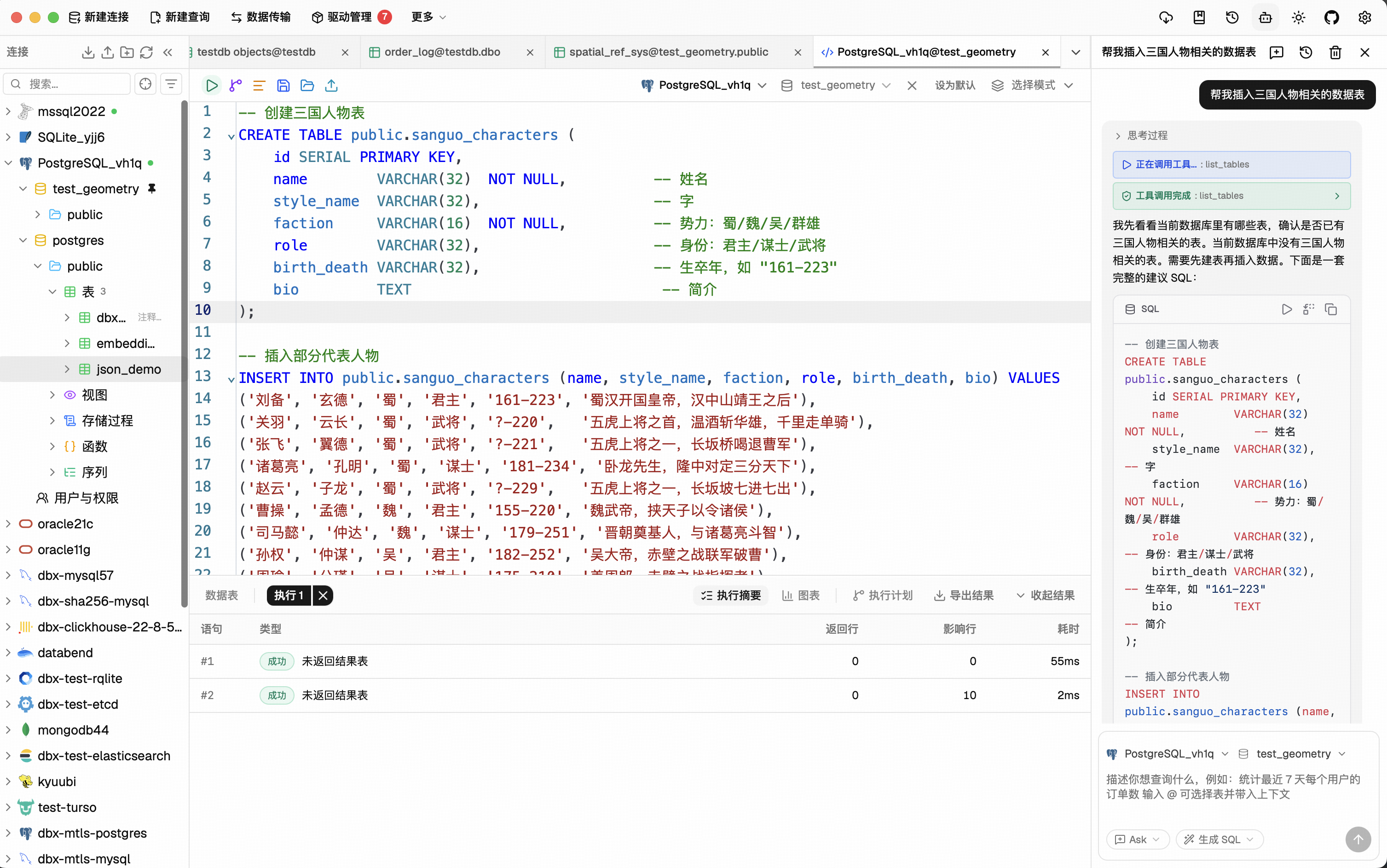
🤖 AI that lives in your editorHighlight a table, describe what you want, get SQL back — no copy-paste between tools. Works with Claude, OpenAI, or local models via Ollama. Built-in safety checks review AI-generated SQL before it runs. |
🔌 MCP: your databases, AI-readyDBX speaks the Model Context Protocol. Claude Code, Cursor, Windsurf, and other AI coding agents can query your databases through connections you already set up. One config, everywhere. |
🌐 Desktop + Docker + WebNative app on macOS, Windows, and Linux. Self-host via Docker for team access. Web version for browser-only environments. Same feature set. Same connections. |
Features
70+ Databases, One Tool
MySQL, PostgreSQL, SQLite, Cloudflare D1, Redis, MongoDB, DuckDB, ClickHouse, SQL Server, Oracle, Elasticsearch, Easysearch, Qdrant, Milvus, Weaviate, MariaDB, TiDB, OceanBase, openGauss, GaussDB, KWDB, KingBase, Vastbase, GoldenDB, Doris, SelectDB, StarRocks, Manticore Search, Redshift, DM, TDengine, XuguDB, CockroachDB, Access, HighGo, UXDB, and more. Agent/JDBC-oriented profiles extend DBX to H2, Snowflake, Trino, PrestoSQL, Hive, DB2, Informix, Neo4j, Cassandra, BigQuery, Kylin, SunDB, JDBCX, and custom JDBC connections. New native and agent-driven drivers also cover Databricks, SAP HANA, Teradata, Vertica, Firebird, Exasol, YashanDB, GBase 8a/8s, Databend, RQLite, Turso, InfluxDB, QuestDB, IoTDB, etcd, ZooKeeper, Nacos, IRIS, and more. Message queue admin is also available for Pulsar, Kafka, and RocketMQ. All in a single ~20 MB app. No bundled Chromium.
Query Editor
CodeMirror 6 with SQL syntax highlighting, metadata-aware autocomplete, Cmd+Enter execution, selected SQL execution, SQL formatting, diagnostics, and 9 editor themes. Persistent query history, saved SQL snippets, tab restore, and SQL file execution keep repeat work close at hand.
AI SQL Assistant
Describe what you want in plain language — get SQL back. DBX can explain queries, optimize SQL, fix errors, and run AI-generated SQL through built-in safety checks. Works with Claude, OpenAI, local models, or any OpenAI-compatible endpoint.
Data Grid
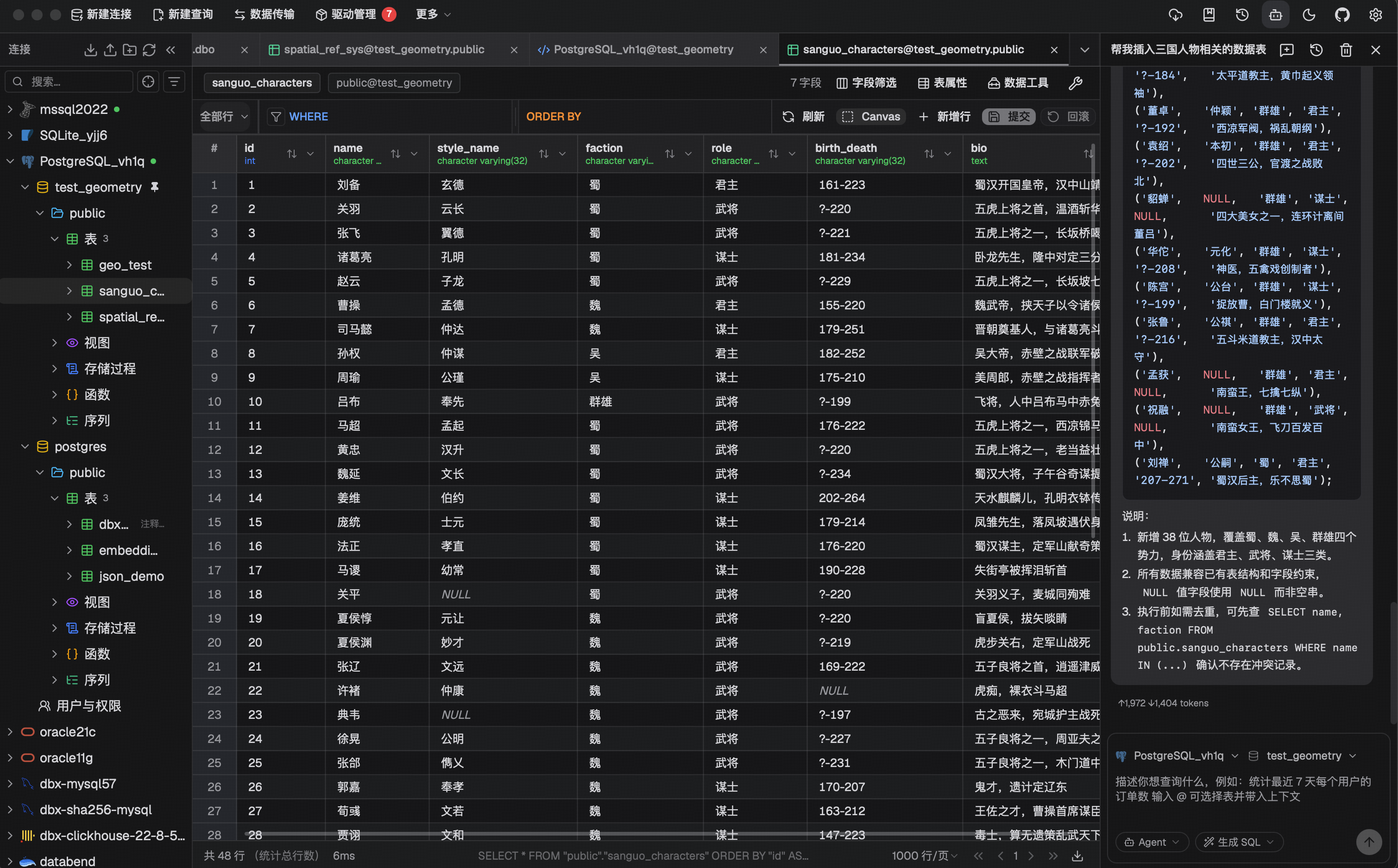
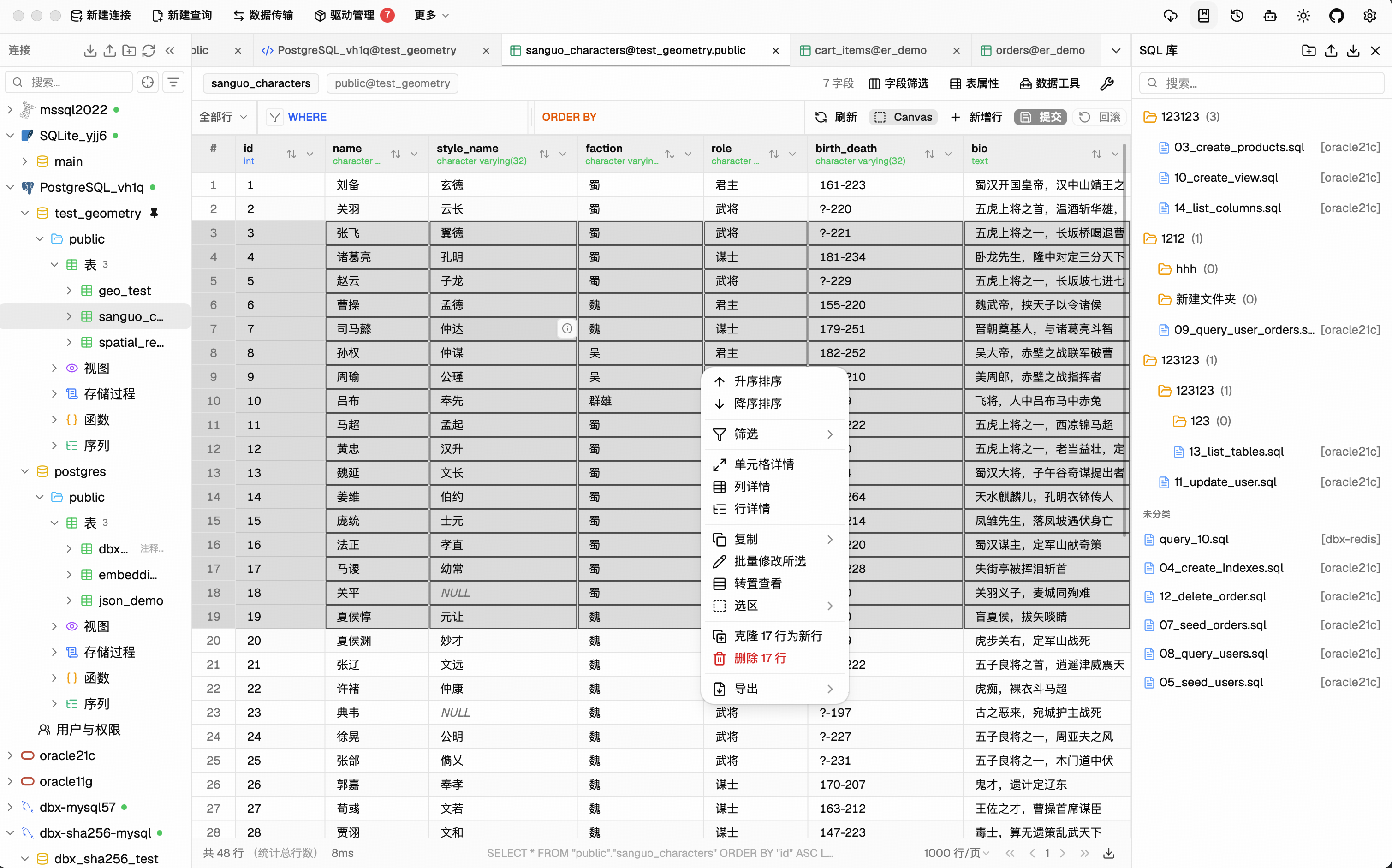
Virtual-scrolled table that handles large result sets. Inline editing, SQL preview before save, WHERE / ORDER BY controls, DataGrip-style filters, LIKE / NOT LIKE context filters, sorting, full-text search, pagination, column resize, auto-fit, row numbers, zebra stripes, and full cell details. Export or copy as CSV, JSON, Markdown, XLSX, or INSERT statements.
Schema Tools
- Schema browser — databases, schemas, tables, columns, indexes, foreign keys, triggers, with sidebar search & pin
- Object browser — grouped procedures, functions, views, and source editing where supported
- Table structure editor — reviewable column and index changes for supported engines
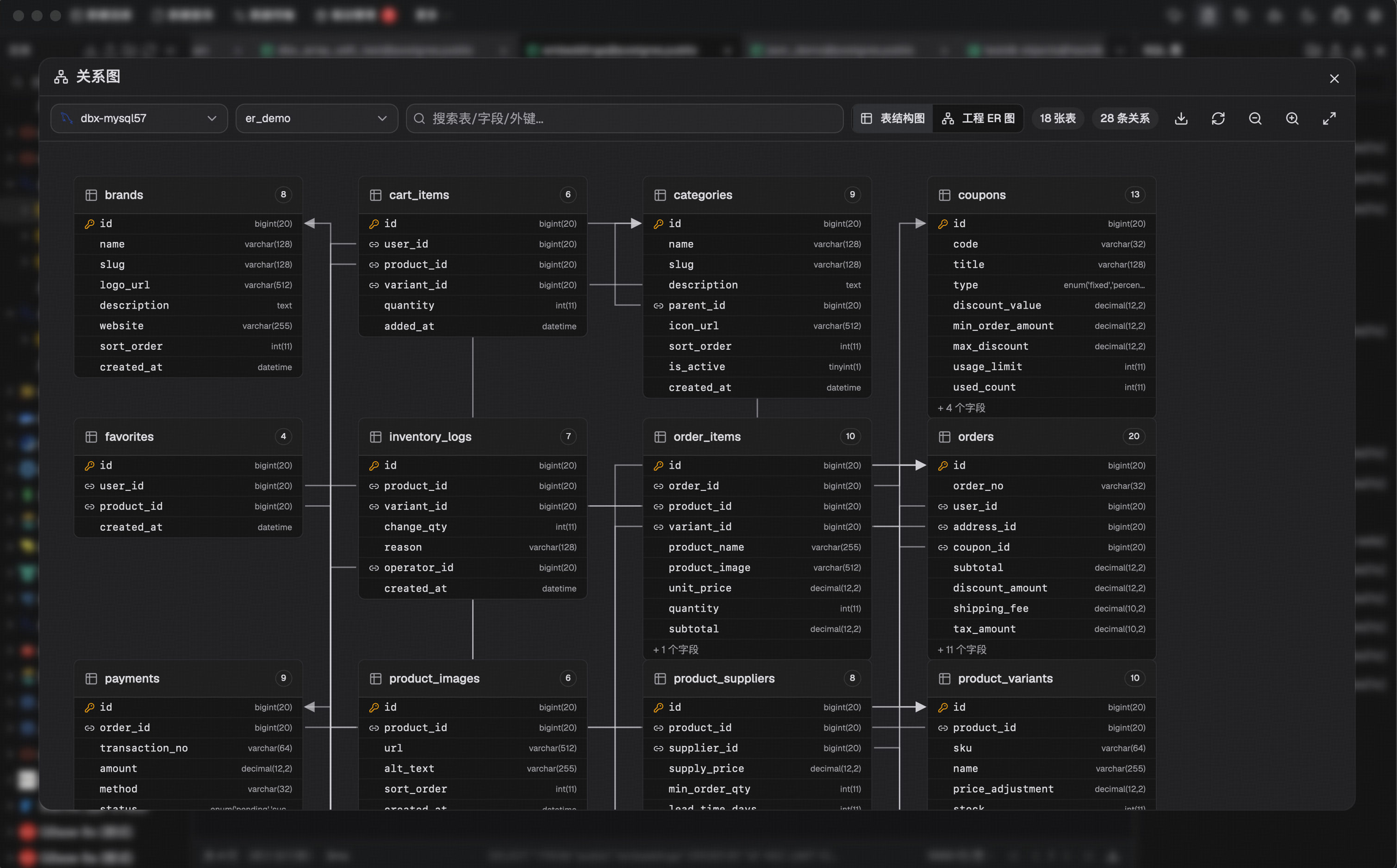
- ER diagram — visualize table relationships
- Schema diff — compare structures across connections
- Explain plan — visual query execution plan
- Field lineage — column-level lineage analysis
- Database search — find objects across large schemas
Data Operations
- Table import — CSV, Excel
- Data transfer — migrate between databases
- Database export — full database dump
- Data compare — compare table data and review synchronization output
- SQL file execution — run
.sqlfiles directly - File preview — drag & drop Parquet, CSV, JSON to preview instantly (powered by DuckDB)
- Connection import — bring connection profiles from DBeaver or Navicat
Specialized Browsers
- Redis — key pattern search, batch key operations, command runner, TTL editing, and all data types (String, Hash, List, Set, ZSet, Stream)
- MongoDB — document CRUD with pagination, Atlas & replica set URL connection
Safety & Connectivity
SSH tunnel (key & password) · database and AI proxy settings · auto-reconnect on connection loss · confirmation dialogs for destructive operations · encrypted config export/import · color-coded connections · driver store and optional JDBC plugin
Polished UI
Dark mode with native title bar sync · 9 editor themes · English, 简体中文 & Español · layout preferences · built-in auto-update
AI Agent Integration (MCP)
DBX provides a separate Rust-powered MCP server that lets AI coding agents query databases using connections configured in DBX. The MCP server is distributed independently from the desktop application, so installing DBX does not automatically install the MCP executable.
npx @dbx-app/mcp-server
Add to your .mcp.json:
{
  "mcpServers": {
    "dbx": { "command": "npx", "args": ["-y", "@dbx-app/mcp-server"] }
  }
}
Manage the connection allowlist and the Read only, Data read/write, and Full access modes in DBX Settings → MCP. The machine-readable values remain read_only, safe_write, and high_risk_write; client configs do not need permission or connection-scope environment variables.
For upgrade compatibility, an existing DBX_MCP_ALLOW_WRITES=0 (or false) remains a read-only restriction only until a central MCP policy is saved for the first time; it can never enable writes or override a saved policy.
Windows portable builds need DBX_DATA_DIR in the MCP config, pointing to the data directory next to DBX.exe (the folder that contains dbx.db).
For DBX Web or Docker deployments, point the MCP server at the Web backend API. If the Web login page requires a password, set DBX_WEB_PASSWORD to the same password used there:
{
  "mcpServers": {
    "dbx": {
      "command": "npx",
      "args": ["-y", "@dbx-app/mcp-server"],
      "env": {
        "DBX_WEB_URL": "http://localhost:4224",
        "DBX_WEB_PASSWORD": "your-web-login-password"
      }
    }
  }
}
Works with Claude Code, Cursor, Windsurf, and any MCP-compatible agent. Supports listing connections, browsing tables, executing SQL, and opening tables directly in DBX's UI.
Precompiled native binaries are also published for macOS, Linux, and Windows in package releases. They run without Node.js and are suitable for offline or server environments. The npm installation uses the same Rust binary through a small Node.js launcher.
DBX also provides a dedicated CLI package for terminal, script, and Codex workflows:
npm install -g @dbx-app/cli
# or via Homebrew
brew tap t8y2/dbx && brew install dbx-cli
dbx connections list --json
dbx query local "select 1" --json
See the MCP server README and CLI README for details.
Install
Download the latest release from the Releases page.
Homebrew (macOS):
brew install --cask dbx
Scoop (Windows):
scoop bucket add dbx https://github.com/t8y2/scoop-bucket
scoop install dbx
WinGet (Windows):
winget install t8y2.dbx
Flatpak (Linux):
flatpak remote-add --if-not-exists flatpark https://dl.flatpark.org/flatpark.flatpakrepo
flatpak install flatpark com.dbxio.dbx
Updates then arrive through the regular flatpak update. See the DBX page on FlatPark for details.
Self-Hosted (Docker)
DBX provides a web version that can be deployed via Docker. The examples use
the latest tag to pull the current release.
docker run -d --pull=always --name dbx -p 4224:4224 -v dbx-data:/app/data t8y2/dbx:latest
This uses the cross-platform dbx-data named volume. Users in China can use
the CNB image, docker.cnb.cool/dbxio.com/dbx:latest, for faster pulls.
For Docker Compose, deploy/docker-compose.yml remains the source-build
configuration. To deploy a published image, use
deploy/docker-compose.release.yml:
docker compose -f deploy/docker-compose.release.yml up -d
services:
  dbx:
    image: t8y2/dbx:latest
    # For faster pulls in China, use the CNB image instead:
    # image: docker.cnb.cool/dbxio.com/dbx:latest
    pull_policy: always
    ports:
      - "4224:4224"
    volumes:
      - dbx-data:/app/data
    restart: unless-stopped

volumes:
  dbx-data:
Open http://localhost:4224 in your browser. Multi-arch images (amd64 / arm64) are available.
To publish DBX under a reverse-proxy context path such as /dbx, set the
runtime base path and proxy the same prefix to the container:
environment:
  - DBX_PUBLIC_BASE_PATH=/dbx
When building the frontend yourself with an absolute asset base, set
VITE_DBX_BASE_PATH=/dbx/ before pnpm build.
Getting Started
Prerequisites
System Dependencies
macOS:
No additional dependencies required.
Linux (Ubuntu/Debian):
sudo apt-get install -y libwebkit2gtk-4.1-dev libgtk-3-dev libappindicator3-dev librsvg2-dev patchelf libssl-dev
NIXOS/NIX :
Windows:
No additional dependencies required.
Development
make
make installs root dependencies when needed and starts the local Tauri desktop development environment.
Development builds can run alongside an installed DBX instance and share its local data, including connections and history. Avoid changing the same connection or global setting in both windows at once.
[!TIP] DuckDB compilation takes a while. If you're not working on DuckDB features, skip it to speed up local builds:
# Fast checks (skip DuckDB)
make cargo-check-fast
make cargo-test-fast

# Tauri dev without DuckDB
make dev-fast
The
--no-default-featuresflag only affects local development. Release builds (pnpm tauri build) always include DuckDB.
Web version:
make dev-web       # frontend
make dev-backend   # backend
Documentation site:
make docs
The official DBX documentation site lives in docs/. If you want to improve the website content or documentation pages, edit the files under docs/ and run make docs to preview the site locally.
For clean, reproducible local database instances, use the versioned Docker Compose recipes under deploy/database/:
make db-list
make db-verify DB=mysql@8.4
JDBC agent driver development projects live in agents/:
cd agents
./gradlew test
Build artifacts from agents/drivers/<db-type>/build/libs/ are picked up by local driver install flows when available.
Build
make package
The installer will be in src-tauri/target/release/bundle/.
Tech Stack
| Layer | Technology |
|---|---|
| Framework | Tauri 2 |
| Frontend | Vue 3 + TypeScript |
| UI | shadcn-vue + Tailwind CSS |
| Editor | CodeMirror 6 |
| Backend | Rust + sqlx / tiberius / redis-rs / mongodb |
Documentation
- Official docs — feature guides and tutorials
- Database Test Lab — local database recipes for development and verification
- Contributing — how to pick up issues and open PRs
- Web API reference — HTTP API for Docker/Web deployments
- Examples — CLI, MCP, Docker, and API samples
Community




Support DBX
DBX is free and open source, but ongoing maintenance, database compatibility testing, infrastructure, and release work require sustained time and resources.
Sponsors & Partners

|
RainYun is a cloud service provider offering cloud servers, physical servers, game hosting, and developer-friendly infrastructure services. | Visit RainYun |

|
Qiniu Cloud provides DBX with object storage, CDN, and other cloud infrastructure resources. | Visit Qiniu Cloud |

|
Easysearch is an enterprise-grade distributed search engine compatible with Elasticsearch APIs, combining full-text, vector, geospatial search, real-time analytics, and AI capabilities in one platform. | Visit Easysearch |

|
Atlas Cloud gives developers one unified API for 400+ AI models across chat, image, video, and audio. | Visit Atlas Cloud |
- Support DBX — voluntary donations via WeChat or Alipay
- Sponsors & Partners — sponsorship, infrastructure, tools, and community collaboration